Showing posts with label wheelchair. Show all posts

Wednesday, June 22, 2016

Hello Again

Hello out there. Since it’s been so long since I’ve posted, I'm not sure where to start, so I’ll start at “Hello.”

Sorry for the silence here the last two months. My condition took a sharp turn about a month and a half ago and I’ve spent most of my days since just surviving.

I haven’t been doing well the last few months. I haven’t had a decent night’s sleep in four months. Sometimes I only sleep 2 hours a night. Sleeping and breathing at the same time is not really a thing my body is able to do anymore and that is the main culprit of my insomnia, although it’s not the only reason. But there’s good news on that front (I discuss more below).

Since I haven’t been sleeping well, the weakness in my limbs has turned to paralysis. Not having use of my limbs makes typing really challenging. Thus, I haven’t posted. 

A month and a half ago, I woke up one day and felt the heaviness in my limbs, the signal they send me to say “you have little use of us today and if you over-do it we’ll shut down completely. Good luck!”

I heard what they told me but I loaded the dishwasher anyway. I said “I do what I want! You don’t own me.” I moved too much anyway. I pushed too far. Bam. My muscles completely shut down. Typically, I can rest for a few hours and they’ll come back to life, but it was different this time. 

I haven’t been able to stand or walk since and my wheelchair is my constant companion now.

My BFF always jokes that Myasthenia Gravis sounds like a Harry Potter spell. If it was a Harry Potter spell, it would make your limbs turn into gummy worms.

The first few weeks when this started I needed help with every basic task, including getting to the bathroom. Since then, I’ve gotten some of the independence I had before back, but I still need help showering and making food. I can't help with any cleaning. We have to prepare my food the day before. I still have intermittent use of my arms.

I've lived in fear of this the last year. I have had periods where the paralysis intensifies and I can barely get around my house with my cane, or I'm not able to walk at all. But the longest I've ever been unable to walk is 12 hours. This is a new normal indeed.

My whole body has become so weak and deconditioned without any movement at all. All this time I’ve been trying to imagine how I’m going to rebuild my strength. It’s a daunting task. Imagining just walking from my bed to my bathroom again feels like climbing Everest. There’s no chance to rebuild my strength right now because any time I try to use my muscles the more the paralysis sets in. That’s typical for Myasthenia. Using muscles draws the antibodies from your blood into the muscle, making it weaker and weaker.

So I’m not completely sure how I’m going to climb out of this. I’m honestly just trying to go with it, take it day by day and moment by moment. My body makes the rules so I'm just trying to finally learn how to follow its lead and not fight against it. The harder I fight, the more I sink in the quicksand. It's better just to roll with it, literally. 

So I continue to wait.

When the paralysis was so intense that I needed help with every basic task, husband and I packed a bag and planned to head to the ER. I mentally prepared myself for a long hospital stay. But my neurologist (who has been minimally helpful during this health crisis) told us not to go to the ER unless my breathing completely shut down. My packed hospital bag is still sitting on the floor in our room just in case.

It’s incredibly frustrating. I had been making progress with yoga the last 6 months, I had been able to walk farther than I had been able to almost a year in Febraury, and now it's gone. I keep thinking “what did I do? How did this happen?”

I think I have an idea of what happened. I got over-ambitious. I was in denial about how much I have declined in the last 6 months in general. Ever since that day that I screwed up, took my body for granted, and tried to play with my nephew for a few minutes back in March, I haven’t been the same. That started the insomnia and the constant insomnia turned the usual muscle weakness into paralysis. I started a higher dose of the medication I use to sleep and I think that played a role too. 

I think that’s how I got here.  But it’s often fruitless to backtrack and try to figure out how or why. Illness often has a mind of its own and control is an illusion. Trying to find a narrative that explains the 'how' and 'why' often is a pointless endeavor.

Although this crisis has been challenging for husband and I, we have started adapting to it. I have adjusted to using the wheelchair all of the time pretty well. We’ve come up with solutions to help me maintain some of my independence and preserve the strength and energy I have. Each night, husband prepares my breakfast and lunch for the next day.

It may sound strange, but in some ways this crisis has given me more resilience. I was extremely depressed the few months before this because I was having difficulty exercising, walking, or seeing any of my friends and family. Yet, this has given me a huge appreciation for the independence and mobility I had. It has given me more determination to move again and get my strength back.


Bella appreciates having another place to sit

I haven’t been able to play my keyboard in two months, the longest I have ever gone. That, more than not being able to walk, has been the most devastating part of this. But I’m determined to be able to have enough use of my arms and enough energy to play again. I want to go back to the assisted care facility where my mom lived to play for them again in the near future.

I’ve been listening to a lot of music, especially playing my vinyl collection, and reading (follow me on Instagram to see pictures of my vinyl collection. I'm @StefanieShea over there). I’ve even been able to wheel myself outside sometimes. Husband and I have been watching a lot of Star Trek. Even though I’m still not well, I still feel satisfied with life in many ways. 


In times like this, I've learned you have to find strategies to not let frustration overwhelm you. It can start a fire that consumes every part of your life. You have to fiercely guard what joy you still have. Ultimately, I've learned gratitude is the antidote to suffering. 

To the good news:
A few weeks ago, I had an appointment with my pulmonologist. I haven’t made it to any appointments with any of my doctors this year and the only test I made it to was my pulmonary function test in April. Everything else I have had to cancel because I wasn’t well enough. I was in terrible shape and not able to travel but I had to make it to this appointment. I had to tell my doctor that breathing and sleeping have become even harder.

It was over 100 degrees that day, making the trek to the next town over to see her even more challenging. But husband created an elaborate game plan to make sure I was comfortable and able to make it.

I started crying as soon as we got in the room. I could barely talk to her nurse. I don’t cry in appointments anymore. It wastes time. I always have my game face on and a detailed list of questions and points to discuss. When my doctor came in, I was still a weepy mess. I could barely use my limbs or sit up and I was exhausted from traveling and suffering. It was too much.

My pulmonologist is incredible. I wish every doctor had her empathy and compassion. She was distraught at my condition and my emotional state. I’m usually all smiles and business when I see her, no matter how terrible I feel. I asked her again if there was any way I could get a breathing machine finally, something we’ve been talking about for a year since the respiratory muscle weakness from MG has been my most difficult symptom to manage the last few years. She said she’d do everything in her power but she thought my insurance would not cover it. I left incredibly disappointed. The inhalers she gave me and the canned oxygen I buy online are not enough to offset my breathing difficulty and it is the major culprit for my insomnia, leading to my declined state. 

I've heard "this treatment will help you but your insurance won't cover it" so many times. That's the reason my neurologist hasn't been able to start the standard MG immunotherapy for me.

A few days later we got a call that I had been approved for a BiPaP machine. Wait. What? How? We couldn’t believe it! I don’t know how my doctor did it but I need to send her some flowers.
Two respiratory nurses brought the machine over last week and showed us how to use it. The first night I tried to sleep with it on and ended up only sleeping a few hours that night, long after I took the mask off. It’s going to take some time to be able to fall asleep with it on. I’m having a lot of trouble sleeping even without an uncomfortable apparatus attached to my face.


But I’ve been using it during the day, before bed, and when I wake up at night not breathing and what a difference it has made. WOW! Who knew breathing was so great? The only problem is my insurance didn’t cover the full cost of the machine. Our monthly co-pay for it is $100, which is steep. We looked at our budget and worked things around to make it feasible.


The day I got my machine, my best friend created a GoFundMe page to help cover the cost. I guess my closest friends had been planning this as soon as they heard I was approved for the machine. I was considering asking them to take it down but my friend explained that people wanted to help and they had been looking for a way to help. Friends, family, and even strangers contributed.

I am astonished at their kindness. It has been an elixir of hope the last week knowing so many people were rooting for me and wanted to help us. We are so grateful for the love and support.

So right now I’m working on getting adjusted to the machine and crossing my fingers and hoping I can start building my strength again. I’m hoping to get back to blogging regularly again. I can’t believe it’s been two months since I’ve posted. For any of you still reading, thanks for hanging on and bearing with me.

There have even been days where I have enough strength to do fun things, like re-plant our Stonehenge garden.


I have also learned that when you live a life of limitation and the most excited thing you have to look forward to is leaving the house for blood work or an appointment, you have to create things to look forward to and focus on them instead. This week is our 10th wedding anniversary and we're going to have a big party with our friends and family. We had always planned to drive to Yellowstone for our 10th, but that's not possible. A party is just as great. We're going to Monterey in a few weeks to stay for about a week with some friends. It will be the first time I've left my town for something other than an appointment in two years! We have friends and family coming to visit from other states in the next few months. Despite the obvious drawbacks, life is pretty good.

And you have to hold fast to that.

To better days ahead for all of us…..


Thursday, April 28, 2016

Surviving the Worst


Well. I’m slowly climbing back from the worst rough patch I’ve ever had, but I’m here. I’m writing. My arms work well enough to type again. This is progress.

From the last few posts, you can see that the last few months have been one long rough patch, but it took a sharper turn the last week. The thing with experiencing the worst is it’s like a nightmare taking tangible form. The world drains of color. Nothing brings joy or relief. I couldn't see the other side, and it felt like I would never climb out.

But I am getting to other side.

I’ve had some really severe insomnia for about a month and a half. I am a lifetime insomniac and go through periods of not sleeping well but this was different. I was only averaging 3 hours a night and some nights, I only slept about an hour, long after the sun came up. The thing with illness is sleep is the center which all forms of symptom management orbit. If you don’t have sleep, it doesn’t matter how much you rest, eat well, exercise, etc. Without sleep, everything else is pointless.

I tried all my usual tactics, including changing my sleep medication. But the reason I was having such a difficult time sleeping is I was having to spend a good portion of my time in bed during the day and I was constantly waking up in the middle of the night because I wasn’t breathing. The latter is not an uncommon occurrence but the less sleep I got, the worse my breathing got and the more time I had to spend in bed. It was an unending cycle I couldn’t break.

I don’t know how people who have to spend all of their time in bed do it, but being bedridden is always a ticket to insomnia-ville for me. I also kept over-doing it as always and making myself bedridden again.

I did manage to make it to my pulmonary function test two weeks ago though. I’m hoping to write a post about it since it’s a standard test for Myasthenia. It’s a brutal, exhausting test that includes such exciting activities as breathing into tubes, hyperventilating on purpose over and over, and getting locked in a glass pod. It was nice to show up though and it’s the only test I’ve made it to this year, so it feels so good to check it off the list since I won’t have to do it again for another year!


But I didn’t rest properly after the test and ended up bedridden and back at insomnia-ville again.

But then my body had had enough and my muscle weakness turned to paralysis. Paralysis can come at any time with Myasthenia but this was the worst bout I’ve ever experienced. I couldn’t get to the bathroom without help. My husband had to push me around the house in my wheelchair, two thresholds I have been dreading and hoping wouldn’t happen for a long time or never.

We made arrangements to go the hospital but I had my husband call my doctor to see if that was the right choice. My doctor said that if the paralysis entered my respiratory muscles, then we needed to go. Even though I had little use of my limbs, I was actually breathing ok, for me at least. A healthy person would still assume they were dying. Going to the ER is stressful and offers serious risk. I knew I needed sleep and rest and I was not going to get either of those there. Also, my doctor has still not authorized immunotherapy—steroids and IVIG—for me, which is standard treatment for Myasthenia. I really don’t know what they would do for me at the ER. So I pushed through it. Survived moment to moment. 

It’s a skill I’ve gotten really good at. I’m an epic level survivor.

I haven’t had to spend any time in bed the last three days. The paralysis is starting to subside and I’m sleeping better. I don’t know if I have turned the corner yet but I feel like I’m getting there. The world has some color again.

I’ve been practicing what I call “militant resting,” moving as little as possible, focusing on my breathing, and giving my body the patience and care it needs. Now if I could just stop over-doing it and let my body recover, that would be great.

I missed my MRI at Stanford again and sent a message to my doctor asking for another option, hopefully to do the MRI locally since this is the 4th time I’ve had to cancel it. I have another appointment there in two weeks. I really need to improve so I can finally show up.

I got my fancy, new record player that was my gift to myself for winning my short-term disability case and I’ve been lying on my couch listening to a lot of music, many of my albums I haven’t listened to in a long time. Music the best kind of medicine; it can be auditory resuscitation. As something fun and uplifting, I've been working on taking pictures of some of my vinyl collection I’ve been accumulating the last few decades. If you want to see it, follow me on Twitter or on Instagram.


It feels like there are shades of normalcy in life again and I'm working hard to get there. My husband has been the unsung hero in this awful saga. He is always the one who deserves all the glory. The last few months have easily been harder for him than for me since he has to care for me, while working and doing everything else. This was the first time I have needed help with every task so I've been working hard to get back to some functionality again. I'm definitely getting there. We survived it together like we always do and watched all of "Cut Throat Kitchen" while I rested.

Since my condition continues to decline and I've struggled to show up to appointments and tests to finally make headway toward treatment, I have this overwhelming sense of dread and fear. What transpired last week did not help this. But I have decided that I won't live in fear of the future and what may come next. I want to try to enjoy each day--laugh with my husband, listen to music, watch the birds in my yard, do everything I can do enjoy each moment.

When I was feeling at my worst, I wrote a poem to remind myself of this:

I refuse to walk in fear
To tread in trepidation
To worry what each corner brings
But instead
To wake each day to a fresh start
And face that possibility with an embrace
Each corner is a new chance
Something to learn, something to fight, something to laugh with
But I refuse to walk in fear toward it
Not anymore 
Instead, a gesture toward hope


I hope all of you are doing well out there. I'm hoping to get back to regular posting again soon. Peace and love to you all :)

Thursday, February 18, 2016

When You Have to Use a Disabled Parking Placard


I see it almost daily. In the health communities I’m in, someone will say “I need to get a disabled placard but I’m afraid to.” I see the images of awful notes left on the car of someone who uses a placard. You can find examples here, here, here, and here. I could keep going.


This discriminatory BS needs to stop.

I too had tremendous ambivalence about asking my doctor for a disabled placard. I didn’t even consider it an option until my mobility issues started in 2013. I was at the point where I had to drive between my classes and buildings on the college campus where I was teaching because I could no longer manage the walking. Anyone who has been to a college campus knows that finding a parking spot, just one spot, is worth its weight in gold. But I was having to find multiple parking spots all day while trying to get to class on time, and I would inevitably only be able to find a spot far in the back, which made my driving to get nearer the building pointless. It was becoming a daily crisis for me as I was desperately struggling to have enough energy to keep teaching and getting through the day. I could not waste all the energy I had trying to walk any distance and failing. 

So I went to the doctor I trusted the most, my cardiologist, to ask him to sign the form. I printed it off the DMV website. Then I felt completely ridiculous asking for a disabled placard, no matter how desperately I needed it. I even told him how absurd it felt to ask him for it. He signed it without question. I still was not comfortable with the term “disabled” then and I was still trying to pretend I could physically do what I was longer able to do. "Passing" as able-bodied is significantly easier than trying to live with disability, and I was coasting on denial as long as I could. But I asked him to sign the form because I needed to be able to work. I justified it to myself by saying “I’ll only use it on the days I really need it. I won’t take up a spot for someone who really needs it. I’m not technically disabled, and I don’t want to endure anyone’s ridicule or derision because I ‘look fine.’ I won’t use it very often.”

But I was wrong. I was and am disabled. I got the placard and ended up using it every day because it was a life saver. I wished that I had gotten it sooner when I needed it, long before I finally talked to my doctor about it. I wish that worrying about what others would say or the fear that someone would leave a nasty note on my car wouldn’t have gotten in the way of me using an invaluable resource I needed.

There are many who are going through this right now and are debating whether they should get a placard and if they want to deal with the discrimination that can come with it. They probably read these horror stories every day and see the nasty notes people leave on someone’s car because not enough people understand that most disabilities and chronic conditions are invisible.

I imagine there are a variety of reasons people leave notes on cars or make discriminatory comments to the disabled. They may believe they are standing up for those who are “actually disabled,” acting as vigilante warriors protecting a “privilege” that only a select few are “entitled” to. They may believe that people are exploiting the system for personal gain or even feel envy that someone has access to a prime parking spot anyone would want. They may assume that all disabilities are visible and that only individuals who require a mobility aid qualify as disabled.

When someone leaves a note on a car or makes a comment, they are making rash judgments about someone they’ve never even met and enacting a gross injustice on someone who faces daily obstacles already.

This needs to stop.

I count myself  “lucky” because I’ve never had a note left on my car. I had to start using a cane right after I got my disabled placard so my disability was no longer invisible. I have gotten harsh stares or questioning glances when I have used the motorized carts at stores. The last time I drove myself to a store and used the electric cart (it’s been years now since I could do this), an elderly man got angry with me because I used the last one. I needed it as much as he did. I was just trying to pick up my medications without falling or fainting in a store. Now, when I leave the house I have to use my wheelchair almost all the time.

I bring my own chair, thank you very much.

When someone who doesn't "look disabled" uses a disabled placard or an electric cart, we need to remember these points:

 1. Most disabilities and chronic conditions are invisible. Often, you cannot “see” kidney disease, cognitive disabilities, neurological conditions, cancer, prosthetic limbs, mental illness, etc. All of these and more qualify as disabilities, and these individuals are allowed access to a disabled placard to make their lives and the world that much easier to navigate.

2. Police officers, parking attendants, etc. can ask someone to show them the permit that the disabled are required to carry when they use a placard. People do not need to enact their own form of vigilante justice. There is a system in place to make sure that those who use the placards are permitted to use them.

3. No one is entitled to an explanation or “proof” of someone’s disability, especially if you do not know the person. No one is required to “prove” their disability to anyone. Believing that someone is required to explain their disability is pure ableism.

 4. If someone would like to help the disabled, there are better ways to do this than by leaving notes on someone’s car or making disdainful comments. 

You can support legislation that helps the disabled. We have the Americans with Disabilities Act in this country but the law is not perfect. We need more laws and protection for the disabled so that they can enjoy the same privileges and access those without disabilities enjoy. You can spread the word that many disabilities are invisible and learn more about why disability and illness are often considered “invisible.” You can educate yourself about all that qualifies as a disability and see that 1 in 5 people in the U.S. are disabled.

 5. There are essentially no upsides to having a disability. The disabled face hurdles every day that the able-bodied cannot fathom. If you are concerned that the disabled are getting a “privilege” that is somehow “undeserved,” you are entitled to your opinion but don’t act on it. Our society treats the disabled as a protected class and enables them tools to improve their quality of life so they can be full participants in our society. The ADA was only passed in relatively recently, 1990, and it provided legal protection from discrimination and made accessibility in public places for the disabled the law. We should celebrate the fact that those with disabilities have access to tools that improve their lives.


For any of you out there who are putting off getting the placard because you fear the ridicule or are struggling to recognize yourself as “disabled,” I know what you are going through but we must use every means available to us to help us succeed. Even if someone does leave a nasty note on your car or makes a disparaging comment to you, you can keep fighting and you can survive it. It comes from ignorance and we can only hope that someday they will understand the injustice of their act. You are making the right choice in protecting your health.


Don't let anyone diminish the choices you have to make to achieve a higher quality of life. 


Thursday, December 3, 2015

Let's Talk About that Kylie Jenner Image


I want to respond to something that happened this week that I'm still trying to make sense of.

Perhaps you have seen that image above of Kylie Jenner in a wheelchair on the cover of Interview Magazine and heard about the backlash from it. I’m sure like many of you, if I see anyone from the Kardashian clan mentioned in an article I ignore it. I’m convinced every time someone clicks on a Kim Kardashian article, an angel loses its wings. 

Yet, this image irked me. Most people are blaming Kylie, but I honestly doubt she made any conscious choices besides agreeing to pose for the images for profit. It was the choice of those involved at the magazine to use a wheelchair as a prop. She was literally along for the ride. As the backlash to the image began, it’s a comment from a representative from the magazine that irked me the most:

"At Interview, we are proud of our tradition of working with great artists and empowering them to realize their distinct and often bold visions. The Kylie Jenner cover by Steven Klein, which references the British artist Allen Jones, is a part of this tradition, placing Kylie in a variety of positions of power and control and exploring her image as an object of vast media scrutiny." 

I’ve been trying to formulate why exactly this image and comment are so problematic and I want to be able to communicate this from my standpoint as a disabled woman.

The problem is the choice to use a wheelchair as a prop to highlight Kylie’s supposed vulnerability because of media scrutiny fetishizes societal views of the “powerlessness” of the disabled. The “media scrutiny” has been incredibly profitable for her and is being falsely correlated to the experience of the disabled here. This is essentially disability tourism, trying to inhabit a marginalized position without the physical or cultural realities the disabled experience, such as navigating a world that is not designed for us. The editorial staff can delude themselves that they are making a political statement or high art. But we have to call it what it is: distasteful and offensive.

Disability, like other facets of identity, is a label externally and legally defined by society and not one that is chosen.  It is a label that can come with a certain level of marginalization, and like many externally-defined labels, stereotyping. The stereotype of the “restriction” and “powerlessness” of disability is fetishized and even parodied in this image. This parody silences the truth that a wheelchair is a tool for the disabled that enables freedom, access, and independence.

The ADA just celebrated its 25th anniversary and the disabled are a protected class of citizens, but this was not always the case. It’s important to remember this. Yet, the disabled continue to face hurdles with full employment and participation in society. I mentioned in another post the limitations of the ADA and that the disabled continue to deal with limited accessibility in public and private spaces. These are some of the material realities that are invisible in this image.

The disabled are often treated as invisible in society. If you look at media, you will see very limited representations of the disabled and often you will see disability given a negative connotation—it’s treated as some sort of obstacle to “overcome,” a physical vulnerability, or a reason for pity or empathy. Disability is also often defined rigidly as a physical manifestation that is visible to the able-bodied, as if every disability could be “read” at a glance. Disability is not defined by using a wheelchair. Disability comes in a variety of forms and most of them are invisible. 

It’s not the fetishization that makes this image so disturbing for me. It’s the perpetuation of the invisibility and silence of the disabled community. I look at this image and see myself and others represented by that wheelchair and I am represented as a prop. A costume choice. A fashion statement. My experience is not just objectified; it is rendered silent. 

Ironically, though the intention was to make Kylie the subject of this image, the wheelchair has become the subject.

Kylie has never experienced being disabled or dealt with painful scrutiny or pressure to conform to societal expectations about what disability “looks like.” I have lived as able-bodied and disabled now so I have experienced both worlds. We need more voices from the disabled to challenge rigid definitions of disability, to express the experience of being disabled and the struggles and triumphs that come with that label, and more importantly, to show that the disabled are three-dimensional human beings. 

Often injustice comes in the form of a thousand cuts, a thousand slights that slice deeper and deeper into our sense of worth, leaving unseen scars that are continually re-opened. I have experienced derision because of my illness and disability and in the health communities I’m in people share the derision they experience daily. Since becoming ill and disabled, I am witness to injustice every day in some form beyond my own personal experience. Starting this blog is a way for me to give voice to the experiences I’ve seen discussed every day.

I’ve been asked “do you really need to use that cane?” I’ve had medical professionals ask in an accusatory tone “why are you in a wheelchair?” I’ve heard comments about being “too young” to rely on mobility aids. But worst of all, when I’m in my wheelchair and I’m with my husband, I often unwillingly become invisible. People often look through me and speak only to him.

I guess in some ways I’m “lucky” I never had a note left on my car when I have used disabled parking spots because I had to start using a mobility aid right after I got my disabled pass. My disability is “visible” to those who feel they are entitled to “proof” I suppose. I see people post pictures of the notes left on their cars often. I see comments constantly about people putting off getting a disabled placard even though they need one. I did as well.

I resisted using mobility aids because it forced me to “come out” with my illness. I desperately wanted to “pass” and I was able to for some time. If you can “pass,” you can be free of this derision, or the prying questions, or the constant staring. I put myself in constant precarious situations when I was trying to pass and forced myself to do things I physically could not do, ultimately making myself worse in the end.

It wasn’t worth it.

I’ve only recently began to get comfortable with the label of being “disabled” and what comes with that label. I didn’t choose this label. It chose me. My self-image has been radically transformed and how others view me and treat me in the world has also changed. It’s been a tremendous hurdle adjusting to this, but I’m getting there.

I put using off a wheelchair for a long time, even after my doctor gave me a prescription for one and my husband insisted that I needed to finally accept that I needed one. Once I finally started using a wheelchair, I realized I had so much freedom. I could go somewhere without having to immediately find a chair. I could navigate stores again. I could leave the house with more success. I didn’t have to count the steps from my car to a door to try to figure out if I could make it. This sense of freedom negated the comments and the staring. They just don’t really get under my skin anymore. I don’t have to “prove” anything to anyone. I’m just living my life and doing what I have to do to live it the best I can. All that time I put off using a wheelchair was wasted time.

My wheelchair gives me power. This is something that the editorial staff at Interview Magazine or people who question my need for mobility aids don’t understand. Fetishizing societal views of the “powerlessness” of the disabled perpetuates a one-dimensional stereotype of the disabled. The gilded wheelchair used as a prop is a perfect metaphor for the vacuity of the stereotype they are peddling in the image.


The voices of the disabled responding to this image or any issue related to disability should be privileged and heard to challenge the silence perpetuated in this image. This image represents one of the thousand tiny cuts of injustice and though it may be a minor cut, it deserves analysis to avoid more cuts in the future.


You can read more articles commenting on the disabled view of this image here, here, and here 

Monday, September 14, 2015

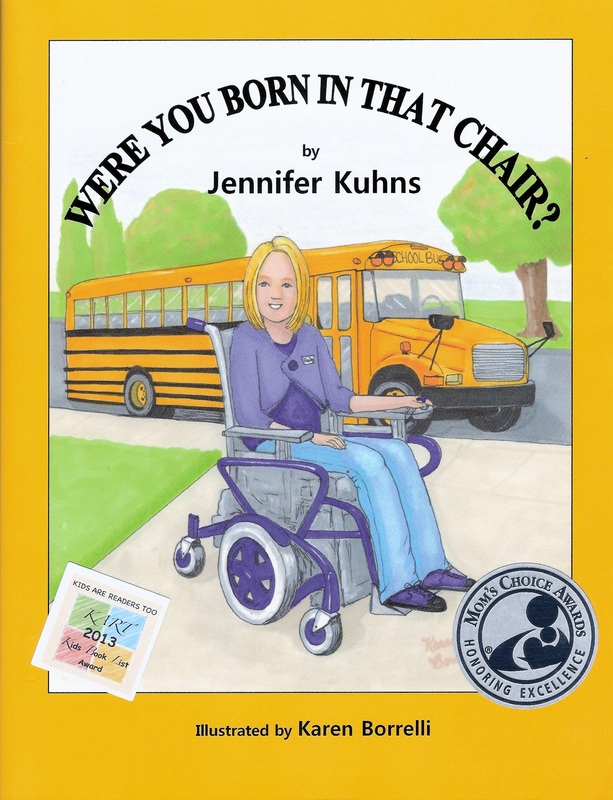
Interview with Children's Author Jennifer Kathleen Kuhns

Today’s post features the voice of Jennifer Kathleen Kuhns, a disability advocate and children’s author. This post has been in the works for some time but since my health has been up and down over the last year, it’s taken awhile to finally get it up. Jenny and I met while working on our undergrad together. We had a few classes together and I got to know her and her mother, her caregiver, over a few years. She was always wickedly smart, determined, and funny. She was also the first person with Cerebral Palsy I had ever met.

Although it pains me to say the time we shared in classes was about 10 years ago, one of my strongest memories of Jenny is the poem she shared in our creative writing class. The poem was about her experience at a zydeco festival, and I had not realized what a gifted writer she was until she read that poem. The fact that I remember this poem all these years later (considering how terrible my memory is) really demonstrates her gift.

We didn’t cross paths again until about a year ago and since then we have been corresponding through email. She has been telling me about her books and her academic work and I’ve been telling her about my conditions and transitioning from able-bodied to disabled. 

She has decided to write her next book about a young boy who is diagnosed with POTS and I have been trying to help her gather information for that book. It will be the first children's book about POTS! Because her work is so important, I asked if I could interview her for the blog so she could share her work with you and thankfully she accepted:


1.Tell everyone a little about yourself.

My name is Jennifer Kuhns and I am a thirty-five year old author, painter and poet.

I also happen to be disabled and in a wheelchair.  My disability is classified as quadriplegic Cerebral Palsy.  I grew up in Hollister, California with my parents and two siblings.  My mom says that very early on I developed an odd, but very funny sense of humor…and an acceptance of other peoples’ actions toward me…although I do hate being patted on the top of the head like a pet dog.  As far as being disabled, I of course have limitations, but that didn’t stop me from joining 4-H and FFA. 

I graduated from San Benito High School in 1998.  I then attended Gavilan Junior College in Gilroy, Ca. where I received my AA degree.  I then transferred to CSU, Stanislaus where I earned my BA in English and Master’s degree.

While in college working toward my Master’s degree I conducted extensive research on the topic of folklore and literature for children, and came to the realization that children's folklore in the form of literature is an important tool for a variety of reasons. It is my opinion, beginning with folklore, that children's literature opens up an entertaining portal for children to be taught about and to examine life through the transcendent power of literature. I truly believe because children have such levels of imagination and acceptance, literature has the potential to change perspectives and create new views.  My passion resides in literature and education without prejudice for children, as well as helping children understand that being different isn't a bad thing.  I continue to strive toward the idea of inclusion and acceptance in my writing.

I guess what I learned most about growing up and being a disabled person is to try everything you can, don’t give up, and laugh most of all…


2. When did you start writing for children?

I’ve wanted to write almost forever.  When I was in grade school I used to write stories and make little mini books.  The first book I wrote, Were You Born In That Chair?, started out as a two page short story that turned into a play that was eventually turned into the book.   

My biggest issue with children’s books in general, when I was a kid, was that when I was growing up there were not, well, very few books with disabled characters.  Kids like to identify with the characters in the books they read.  I had none.


3. What inspired you to write your first book?  Do you have a personal identification with the character in the book?

The first book I wrote, Were You Born In That Chair?, was actually a question asked of me when I entered my first day as a mainstreamed student in kindergarten.  From that day on, I have always kind of had a “bee in my bonnet” in regards to the attitude toward and treatment of people with disabilities.  Upon completion of an extensive research project, I came to the understanding that a negative attitude is not a state of being, but a learned behavior mostly due to fear and ignorance.  My intent and purpose for writing this book was and is to change the outlook and opinion of society towards people with disabilities, since in reality, every human being has some sort of disability or challenge to overcome.  My hope is to promote an all-inclusive nature of acceptance of imperfections of and by humanity.  I mean really, who in this world is perfect?  As far as having a personal identification with the character…I was/am Hailey.


4. What compelled you to write for children?

As I mentioned before, I have always had a “bee in my bonnet” in regards to the attitudes toward and the treatment of people with disabilities.  I understand, being a person who has a disability, and have lived through the misconceptions, the reality of being stereotyped as being less than whole, as well as prejudged and pitied. My first book, Were You Born In That Chair?, was my attempt to re-position, beginning with children, the outlook and opinion of society towards people with disabilities…..since in reality every human being has some sort of disability or challenge to overcome. 


5. Why is it so important to educate children about disabilities?

My personal feeling and objective in writing children’s books about disabilities is to assist in changing how differences in a multicultural world, regarding disabilities specifically, are presented to and perceived by children from an all-inclusive perspective.  What do I mean….My goal is to write children’s books that children can learn from and help them to understand the world around them…or things parents and teachers don’t know how to approach.  I hope children will learn to ask questions, be compassionate, understand who they are and where they come from, be open, not afraid, be curious, and to look beyond the surface.   


6. What has been the response from parents and children to your books? 

The response has been nothing but positive.  Teachers love the books especially because of the interactive-ability of the book…plays, cutouts, ancestry interests, and so forth.  I have shipped copies of my books all over the country as well as to places such as Canada and Indonesia, many of which have gone to teachers.

Here are a few of the reviews listed on the books:


My daughter and I loved reading Paisley or Plaid…being your very best you. The variety of stories and poems were appropriate for my young daughter at the age of five and also great for my 10 year old son. The stories were creative and thoughtful, and always with a lesson to be learned. I loved the poems and how they were placed throughout the book. The illustrations were adorable and very relatable. My daughter has enjoyed other books written by Jennifer Kuhns such as Hailey’s Dream – Janice Keene, Preschool Teacher and mom of two

This story draws us in from the start with its humor and empathy...an excellent example of the power of narrative to deepen our understanding of the range of human life.  Dr. Keith Nainby, Assistant Professor, Department of Communication Studies, California State University, Stanislaus
                                                                       
I was disappointed to discover that there aren't many published books on the subject of children living with disabilities.  I read Were You Born in that Chair? to my fourth grade students (and) was amazed they were engaged in listening to the entire story!  The story is intuitive and insightful.   -Marianne Gartenlaub, Fourth Grade Teacher   

A Box Full Of Letters is a delightful, entertaining, and educational book for young readers.  A witty story.   - Francisco Jimenez, author of The Circuit, Breaking Through, and Reaching Out

I really enjoyed the lesson Hailey learned.  I think she learned that being in a wheelchair is actually a lot more fun than you
would think. -Audra, 4th grade


7. What projects are you working on right now?

I have recently started research and work on my fifth book entitled Miles to the Moon. I say research because the main character, Miles, is a young boy with something called POTS or Postural Orthostatic Tachycardia Syndrome.  This is a lesser known condition or disability than say Cerebral Palsy, Autism, or Muscular Dystrophy, and I know virtually nothing about it other than a friend developed the condition.  I need to know all I can about what I am writing about before I even start writing.

This is a brief internet definition: (POTS) is one of a group of disorders that have orthostatic intolerance (OI) as their primary symptom. OI describes a condition in which an excessively reduced volume of blood returns to the heart after an individual stands up from a lying down position. The primary symptom of OI is lightheadedness or fainting. In POTS, the lightheadedness or fainting is also accompanied by a rapid increase in heartbeat.

Anyway, Miles is a boy obsessed with the outer space, especially the moon. Like his condition being “cured” for a lack of a better word, going to the moon is a far off dream or reality.


8. What are your goals for the future and what impact do you ultimately hope your disability advocacy will make?

My hope is, beginning with children, to change the outlook and opinion of society towards people with disabilities since in reality every human being has some sort of disability or challenge to overcome.  I think it is best explained by a passage in A Box Full Of Letters where Hailey’s father, Andrew, tries to explain to her what the phrase “change the establishment” means and how difficult it is to do:

"Let's see," Andrew began, "it means that things are done a certain way because someone, in earlier times or in the past, or someone very important or powerful, made the decision that that is the way it is supposed to be done.  That is the establishment.  Usually rules, laws, or the government are what people are talking about when they talk about the establishment.  It is pretty much what and how people think about things.  In this case, your mom is the establishment.  She said dinner was ready, and if you want to get fed you don't argue.  You don't fight the establishment."

I hope, as Hailey learned, that changing people’s views it is totally possible. It just takes a while for people to accept change.  But, as Hailey explains to her dad, “People can totally fight and change the establishment.  Grandma Sophie just told us so."


You can find Jenny's website here  and her Amazon author page with all of her books here