Showing posts with label leaving the house. Show all posts

Friday, July 8, 2016

Vacation!

I’m doing something crazy next week, something I haven’t done in years. We’re going on a vacation! I mentioned this before, but I haven’t left my town for something that isn’t medically-related in two years. 

Seriously. Two years.

I haven’t even gone to the next town over to see my BFF’s new place. She moved there almost two years ago. I haven’t made it to the Bay Area to visit my sister, about a two hour trip. She’s lived there for three years. I haven’t been to our favorite place, Sonora, an hour drive away, in two years, and the last time I went to Yosemite was three years ago. I haven’t even made it to any of my appointments at Stanford this year. I've had to cancel every single one. Travelling has become absurdly challenging, especially this year, so all of that has just not happened.

The last time we left town for something fun was when we went to Tahoe for a week with some friends two years ago. We had a great time. I wasn’t doing great but I was doing much better than I am now. I was still working at that time.  I had just survived the last semester I was able to teach and I was rapidly losing my mobility and independence at that time, but I wasn't completely couch-bound then. We played games most of the day and went out to eat most evenings. I sat on the porch that overlooked the forest and read much of the time. We went to the lake one evening as the sun was setting but I wasn’t able to last long so we didn’t get to watch the sun set.
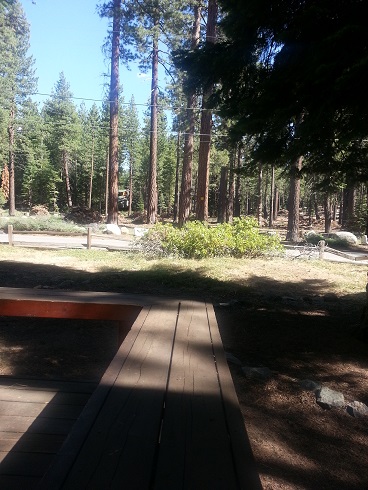
The view from the porch. Ah to live with this view every day. What a dream

I ended up at the ER on the last day we were there. That’s a story I still haven’t shared on the blog yet and I still might someday. If I could create a dream ER experience, it would have been that. I was treated quickly and the ER doctor, who was probably younger than me, had heard of POTS. That ER was incredibly busy. I got an IV and some Zofran and as I waited for the IV to finish we heard someone have a heart attack, someone who drowned in the lake, and the man in the bed next to me was withdrawing from something. The ER doctor forced me to drink Gatorade which I HATE because I declined a second bag of fluids. I just wanted to go home. After one bag, I felt ok enough to make the drive. Anytime I need to go the ER, I dream about go that hospital in Tahoe.

Mustering a smile as the IV worked its magic

We didn’t know at that time that I also had Myasthenia Gravis. I was having difficulty breathing and the lack of oxygen at high altitude did not help. I hadn’t even told my doctors at that point that I was having trouble breathing. The mountain thunderstorms that were passing through made me severely nauseous. It was a bit calamitous but aside from having to go the ER, I look back on the trip with fondness. I had a great time. I’m glad we were able to go somewhere while I was still able to travel. 

I just wish we would’ve stayed at sea level.

So this year we decided to go to Monterey with the same friends and stay in a house for a week. As I’ve been going through the worst health crisis I’ve ever had the last few months, I keep thinking “I have to make it to Monterey. I will make it no matter what.” I haven’t really been focused on much else at this point besides trying to get well enough to make it.  

We planned this trip awhile ago and I always imagined that I’d wake up each morning while we were there and do my usual routine of yoga, stretching, meditation. I never imagined I’d be using my wheelchair full time instead. In a few days, it will be two months since I’ve been unable to walk or stand. It’s not how I imagined this trip but it doesn’t mean I’ll enjoy it any less. We were planning on playing a lot of games too but more than likely I won’t be able to participate much, but that’s ok.

As a lifelong Californian, I've been to Monterey many times over the years so I definitely won't feel like I'm missing out since I'll have to spend most of my time on the couch while we're there. We were planning on going to the Aquarium, and that’s the main reason why we chose Monterey since the only way I could manage a trip to the Aquarium is if we stay multiple nights. I’m not sure I’ll feel well enough for that but it’s not off the table. Not sure I’ll be able to make it to the beach either but I’m definitely going to try. I'm mainly just looking forward to being somewhere that isn't obscenely hot and getting a change of scenery, from my couch to another couch.

I’m going to try to take some time off from being engaged in the world. It’s election season here in the US and I’ve been completely absorbed in that, global politics, and the violence that’s happening here. I may spend all of my time at home, but I’m still an engaged citizen of the world. But I definitely need some time away from that and running through the list of the all the appointments and health management I need to do in my head every day. There’s always something I have to prepare for, plan, make calls about. I’m going to take a much-needed break from it all.

When I get back, I get about a week to rest and then I have to do the worst test ever again (the Single Fiber EMG) at Stanford. But I don’t want to talk or think about that right now.

I’ve been trying to figure out what a suitable number of books bring is. If we’re there for five days, is four too many? What if I run out! What if I have nothing to read! The horror. I’m just going to take it all. Two works of fiction, one of philosophy, one of poetry, and my tablet in case I need anything else. Seems reasonable to me.

It was over 100 degrees essentially every day for a few weeks here. I was telling husband that I don’t even know how to pack for this trip because I don’t remember what 65 degrees even feels like. I’m going to enjoy being able to wear my higher quality compression stockings with jeans and being able to go outside. It won’t get cooler here until November so it’ll be a nice reprieve from the brutal heat.

I went out into public for the first time in months last week and it ended up being a bit disastrous since it was 104 that day. We went to my favorite antique store. I'm hoping that the cooler weather will make leaving the couch a little more feasible but we'll see. 

Husband and I at the antique store. No amount of air conditioning could save me at that point but it was nice to get out

I've been carefully planning for this trip for weeks now. Traveling while ill presents enormous challenges and it's difficult to make contingency plans for every form of chaos that can ensue. I've made a list of everything I'll need to take, including my meds, my breathing machine, shower chair, inhalers, my provisions and electrolytes, etc. Anytime I think of something, I write it down since my memory is unreliable. I'm working on packing a little every day so it doesn't completely exhaust me too much. 

I'm just going to cross my fingers and hope for the best.


I’ll probably be quiet on the Facebook page but follow me on Instagram or Twitter where I might be posting some pictures.


I’m hoping to get a ctrl-alt-delete on life, a nice reboot, and come back feeling a little more refreshed and renewed. I'll be listening to this song over and over, enjoying a little reasonable sunshine. 


Friday, April 1, 2016

Climbing My Way Back

Hello out there. Sorry for the silence here on the blog the last few weeks. I’m working my way back to the world and the blog. It’s a slow climb but I’m making progress.

A few weeks ago, I did something really really stupid. I’m keenly aware of my limitations and I spend so much time managing symptoms and staying within those limitations, but I suppose I needed a reminder that they are still there. I tried to play with one of my nephews. It was just a few minutes of unbridled fun, but it was far more than my body could handle unfortunately. I often feel sad that I can’t participate in the fun when my nephews come over and I worry that they’ll remember me as a lump on the couch, but I should’ve been smarter. I guess all I can do is learn from the mistake and just enjoy watching my husband play with nerf guns with them. That kind of fun is just not feasible for me anymore.

Sigh.

I’ve had to spend much of the last few weeks in bed. I had to stop exercising and my daily walks so I’ve lost much of the strength I had gained. It took me about a week to recover from my mistake but then a severe bout of insomnia and depression took over. I’ve forgotten what it feels like to sleep through the night. It’s been weeks now. Sometimes I get stuck in these insomnia loops that I can't break out of. It's been awhile since I have had one this bad. The irony about insomnia is you think that the more your exhaustion builds, the more likely you'll finally sleep. Nope! It doesn't work that way. No matter how nicely I ask my brain to sleep, it lets me know that it is the boss and does what it wants. 

So this is why I haven’t been posting. I even had to take some time away from all social media for awhile too so I could just focus on surviving. The last three weeks have been a bit of a veritable shitstorm, but I’m trying to remain undaunted. I’ve had rough patches before, even really bad ones like this. I always eventually climb out. It was almost three weeks since I left the house, and I told husband I started to feel like one of those animals that lives in a dark cave for so many thousands of years it eventually loses its pigmentation and sight.

Day 15 Selfie 

The worst part about all of this is I had to miss multiple appointments and the important test I was supposed to do at Stanford last Monday. This test was going to be the catalyst to finally starting the standard immunotherapy used for Myasthenia treatment. At least, that’s what my doctor said. I’ve been waiting for years to finally start that treatment now. It didn’t help my terrible record of showing up to appointments and tests so far this year.

I am continuing to decline overall but I also keep screwing up and setting myself back. I’m sure many of you out there know this cycle: you start to feel a little better, you try to do too much, you end up immobile and back at the beginning. I keep doing this so I’m trying to finally learn from my mistakes and make some changes. Old habits die hard though.

I’ve stopped trying to use my stationary bike. I used to have some success using it and it does help my stamina but the last few times I used it, even when I was having a good day, I ended immobile for a few days. When I’m able to exercise successfully again, I’m going to stick to yoga and my short half block walks with my trekking poles. I was having some success with that. If exercise is only setting you back, then it’s counter-productive. This is what I’m finally learning. Exercise has to enable functionality, not the reverse.

I need to stop trying to do too much on days before appointments. I need to really take the day before to rest so I can show up.

If I do have a moment where the clouds part, the sun breaks through, and I'm feeling pretty good for just a brief moment, I need to not try to do everything I usually can't do to capitalize on that moment. I'm trying to remember that those moments do happen occasionally but they are actually a lie. No matter how good I feel in that moment, my limitations are still the same. Reminding myself of this will hopefully help me just appreciate those moments instead of pushing myself over the edge each time. 

One of my greatest fears in life is making the same mistakes over and over. So I’m really trying to stop asking too much from my body every day and hope we can live in a more peaceful communion.

The last few weeks have been brutal but there have been some bright spots. I try to sit in our little yard when I can. Some days I can’t but when I can I sit out there a few minutes at a time so I don’t crash too hard. It lifts my spirits. 


One benefit of being completely immobilized is I was able to finish two books and I re-watched multiple seasons of Downton Abbey. I also actually made it outside very briefly yesterday. Husband took me to the thrift store around the corner from our house and I got some beautiful framed vintage art. These were absolutely worth pushing myself to finally leave the house again.


My brain is mushy from such little sleep for weeks so this post is a placeholder until I can get some functionality back on all fronts. I have a sponsored post from SaltSticks coming hopefully next week so stay tuned for that. I love their product. I have some other posts I was working on and a few changes in mind for the blog. 

I can feel better days on the horizon.


I hope all of you are doing well out there. 

Friday, January 15, 2016

The Week that Was, January 15th

What a week of ups and downs! I wrote last week that I was finally having an ok week after months of hanging on by a thread and struggling to move, eat, and function. This week hasn’t been as good as last week but good enough for sure. 

-I mentioned last week that we were going to drive to Stanford for my brain MRI this week. It didn’t happen. I rescheduled it for a variety of reason, but mainly because I didn’t want to jeopardize finally feeling a little better physically. Our last trip there in November wiped me out for weeks. Then the festivities of December wiped me out so I just could never catch up. I haven't met my exercise goals in months. Yet, I feel like I’m making a bit of a turn around finally and I wanted to capitalize on that and get back to exercising. It was probably the wrong choice to not show up, but I really needed some time. Also, I have a few local appointments next week I must show up to and a trip to Stanford could risk not being able to show up. My husband and I were so relieved not to have to make the trek there this week and stay the night. I was able to get out and walk instead!


- I see my GI doctor next week for the first time in a year and a half. I need to talk to him about the intestinal infection, constant pain and nausea, struggling to eat, and not being able to put weight back on. But really I’m going to tell him, “eating food is important and everything but what do I need to do to be able to eat Girl Scout cookies when they come in a few weeks?” That is priority #1. 

-My next article, "Why the Fight for a Diagnosis Matters," at The Mighty is up and you can read it here. I wrote about the battle of living on the Hamster Wheel of Diagnosis and why the fight to finally get a diagnosis matters despite the exhaustion and invalidation that can come with it. Most people do not know that the typical time to diagnosis can be six or more years. Most people don’t know that being told “it’s all in your head” by countless doctors is an almost universal experience for people with Dysautonomia and other invisible illnesses. That’s what I was trying to give voice to in this article (and on this blog).

-There was a controversy recently over at The Mighty and some disabled writers have decided to no longer write for them, which I think is a great loss. You can read a bit about it here and you can follow the #CrippingTheMighty hashtag on Twitter to read more responses. I think overall the comments were justified, it started good dialogue between the writers and editors, and The Mighty has made some changes in light of what happened. I decided to keep submitting writing to them because I think it is still a good resource for voices who discuss disability and illness. 

- I celebrated not having to drive to Stanford by finally getting my flu shot. Excitement! Husband works at Costco so he worked all morning, came home and picked me up, and then we drove back over there (that dude is amazing). He got to show me what he has been working on recently and I got to sit on the couches they have. I love couch season at Costco. It’s a nice way to remain in my natural habitat outside of home.


-I haven’t discussed this much on the blog, but I’ve been fighting a very exhausting, protracted battle with the insurance company over my disability insurance. As a public educator, we had to pay into a private system. They awarded me a few months of short-term disability at the end of 2014 but denied my long-term disability and the last few months of my short-term disability. I have not received any benefits since January 2015. I’ve sent them over 100 pages of medical documentation, including letters from my doctors, but they determined that I was not “technically disabled” and am able to do all of the “extensive walking and standing” required for teaching. You could almost laugh at these words.

I have appealed multiple times. My long-term disability case was a lost cause. That part is officially over. But I’ve been trying to find a lawyer to help with my last appeal for my short-term because I have no chance of winning without legal help. Finding a lawyer who will take a private disability case is nearly impossible. So few of them will. Many of my conversations with local law offices went like this:

            Me: “Hi. I was wondering if your law office takes private disability cases?
            Them: “No” *click*
            Me: "Well have a good a day anyway!"

A law office in San Francisco considered my case but months later decided not to take it. I then found a law office in Texas that considered taking my case. They were incredibly kind and easy to deal with and contacted me every week to keep me updated. A few days ago they informed me they ultimately were not going to take my case. I was given six months by the insurance company to appeal the decision but being ill, my mother passing away, and the struggle to find a lawyer ate up all of that time.

I submitted a one letter appeal this week one day before the deadline for my very last appeal. I’m trying to decide if it’s worth trying to find another, third lawyer. I’ve been dealing with this since I stopped working in August 2014 and this battle has caused tremendous stress for me. I've wasted so much valuable energy on this. This is the thing with the American for-profit insurance system: the sicker you are, the more benefits you need. It is a constant fight with insurance companies to get benefits and access to care. It is the job of insurance companies to maintain profits and deny benefits to protect profitability. It’s not personal. That is just how the system works.  

I long for this particular battle to finally be over with. I’m going to try to apply for state disability next, but I will likely be ineligible since I never paid into social security as a public educator. That’s the next battle. The prospect may be that not only can I not work but I cannot even get disability payments to help support my medical costs at the very least. This entire process has broken my spirit a bit. It has definitely had a physical cost. And I’m not alone. The struggle to get access to benefits and care is a struggle for many with chronic conditions.

I should've put a handful of glitter in the envelope when I mailed my last appeal. That would've felt like sweet justice.


-Husband and I left the house to go to the thrift store around the corner yesterday. Thrifting has been one of my favorite activities since I was in high school, and it was so great to get out. Oh, the benefits of doing a little better! This particular store is not very accessible and is really difficult to navigate in my wheelchair but I still like to go when I can. We only stay for a few minutes usually before I start to crash but I’ve gotten really good at making a quick of survey of everything to find some treasures before we go.

-My sister-in-law and baby nephew stopped by for a visit a few days ago. Look at all of this handsome.


-My daffodils I bought with my mom a few years ago have already started to sprout. I can't wait to see them bloom. They are my favorite flower. 


-What terrible news this week that we lost two brilliant souls, Alan Rickman and David Bowie. We watched Labyrinth and one of the Harry Potter movies this week. I have the Harry Potter movies memorized because I’m an unabashed Potter obsessive but it’s always great when husband wants to watch one with me. Rickman steals the show in all of the films and played Snape, the most complex character in the series, brilliantly. What a loss of a great talent.

How do you choose a favorite David Bowie song? It’s so difficult. But this one from Labyrinth has been one of my favorites forever and I learned it years ago. Sadly, I never performed it. It's such a gorgeous song. 

I hope you all had an ok week!


Friday, January 8, 2016

The Week that Was, January 8th

I'm considering trying to write some weekly or bi-weekly updates on the blog to supplement the longer, topic-driven posts I usually write. I always need a reason and purpose for doing anything here, especially to convince myself that this is not an exercise in narcissism, so doing this might highlight a bit of “slice of life” of living with illness, with emphasis on “living” to show that although there is sickness here there is life too. This might help me post more too.

I had a bit of a miraculous week this week. Let the record show, it is possible to have an ok week!

* The last few months have been especially rough. I felt like I’ve been just surviving day to day, so a week where I wasn’t just surviving has been a welcome change. I think the insanely expensive, medical-grade probiotics I’ve been using are helping. I'm taking them to kill my current intestinal infection and to treat the constant oral thrush I have, which is caused by my steroid inhaler and rescue inhaler I have to use multiple times a day. I have to use the inhalers to help offset the respiratory weakness from Myasthenia. Ah, the constant struggle to manage side effects and even side effects of side effects. Sometimes it’s more difficult than managing the primary illness. 

But I think they are helping. With how expensive they are, they better. My GI doctor originally gave me these probiotics and when I see him again in two weeks I need to ask him for a cheaper option because these are out-of-pocket, not a prescription. Oof. 

Designer-priced bacteria
* So I took advantage of this miraculous week and my husband and I went to our local arts center (which we had inexcusably never been to) that’s right down the street. They have an exhibit of one of my favorite artists, Alphonse Mucha. My mom loved him and some of my first memories are staring at the prints she had of his work. Now I have one of her prints and some of my own. The exhibit ends this weekend and I would’ve never forgiven myself if I had missed it. They had some original drawings, some prints and lithographs, and a lot of information about what inspired him and his life. I had no idea that his nationalist sentiments were so pivotal to his work. It was a great experience.


I can’t remember the last time my husband and I went somewhere for fun together that wasn’t appointment-related so something like this was overdue. Despite the fact that my husband is also my caregiver, I’m learning it’s important to still maintain our relationship as husband and wife—to cultivate and nurture that role just as I did before I got ill. We are always trying to come up with things to do together.

The building was luckily very accessible and had an elevator to get to the other floors, which is always welcome. I’m hoping we can go there again when they have other exhibits.

* Although, there is constant debate about whether those with chronic illness and autoimmune diseases should get a flu shot, I get one every year. If you aren’t sure if you should or not, talk to your doctor about it. For me, the risk of getting the flu outweighs whatever risk there is with the immunization. I’ve never had a problem with it. I always get it in January but I swore last year I was going to get it when it came out in October. I still haven’t gotten it.

So yesterday, we headed out to Costco so I could finally get the shot. I was feeling really terrible yesterday (likely the fallout from our outing) so while we were in the car I told husband I didn’t want to go. As we circled back home, we drove by a new thrift store and I suggested we make a quick stop. We went for a few minutes and then husband rolled me over to the used bookstore next to it. I picked up a few books I’ve wanted for a long time. We left the house together for something fun TWICE this week. It’s unbelievable.


I probably should’ve spent yesterday resting or really pushed myself to finally get my flu shot, but I spend most of my life making good decisions and doing whatever my body demands that I do. I guess sometimes it’s ok to not make good decisions in favor of living a little.

* I talk to quite a few Spoonies on Twitter and I had a conversation yesterday with someone in Canada. She posted a picture of an accessible dressing room that looked like a dream but then explained that unlike the Americans with Disabilities Act we have here in the states, Canada has no comparable legislation. Someone else chimed in and said the Netherlands also does not. I had no idea so many industrialized nations, even ones who are politically more progressive than this country, have no accessibility legislation. They have no legal recourse to ensure public places are accessible. It solidified for me that disabled rights are a global issue, not just a national or local issue. Although the ADA has limitations and lacks enforcement, it does provide legal protection and makes the disabled a protected class of citizens in this country. We definitely have more work to do globally.

* When I’m feeling slightly better, it’s like a veil is lifted from my life, the perpetual shadow recedes and I can think about the future instead of just surviving moment to moment or each day. As I’ve been feeling better this week, I’ve been thinking more about changes and additions I want to make to this blog and my ultimate project of writing a book. I still have so much research, reading, and planning to do. I started reading Laurie Edwards' In the Kingdom of the Sick, which I’ve started multiple times but never finished. Eventually I’ll have a review of it in the Spoonie Reads section (along with all the other books I finished recently).

*It's been rainy here all week (who knew that was possible in California?) and playing my keyboard while it rains is one of my favorite things to do. I've been playing one of my favorite standards, "When Sunny Gets Blue," which is a perfect rainy day song: "Pitter, patter. Pitter, patter. Love is gone so what could matter?"


* One of my Spoonie friends who I talk to regularly (I even sent her a Christmas card) sent me a link to this great article about what it’s really like to live with chronic illness, in contrast to media representations of illness. It’s a great read. I also recommend this article from a woman on the patient advisory board at Dysautonomia International about her struggle to get a diagnosis for POTS. 

* I have to do an MRI at Stanford next week so I'm trying to mentally prepare for the long trek. Our last trip there wiped me out for weeks so I'm hoping this trip won't be quite so exhausting.

* I have exercised almost every day this week, wrote two blog posts, and I’m having kind of a good hair day today. A miraculous week indeed.


I hope that all of you are having an ok week.


Thursday, August 20, 2015

Buck Up Buttercup

I think I am turning that corner finally. It’s nice to be a little part of the daylight experience again. Those weeks I was bedridden, my husband was my lifeline to rest of the world. I started wondering if there were still other humans out there. Did a zombie apocalypse happen? Did the machines finally become sentient and take over? I wouldn’t know. I was in bed listening to Enya, focusing all my energy on breathing and surviving.

It’s been a slow climb back. Deconditioning is the enemy with POTS but MG is often the buzzkill for exercise for me. My limbs have minimal movement right now because of the weakness/paralysis, but I am working hard to convince my body it wants to move again. I've been trying to get back to walking and my stationary bike. Slow and steady. I'm moving at a turtle's pace while the rest of the world rushes around me at a hare's pace. Slow and steady.

Willing my legs to move so I can walk with my trekking poles

The last few weeks were some of the worst in some time, but I’m trying to remain undaunted and keep moving forward. The thing with bad patches is they start to feel like they will never end, like sinking into quicksand and every time you move or make effort to climb out you just sink further and further. That's a lesson I hope to learn finally: sometimes you have to just let your body sink and then eventually, with patience and diligence, you make the slow climb out. I'm almost there.

This week has been a significant improvement. I’m taking joy in little things and accomplishments:

One of my friends had a yard sale and gave away many of her vintage clothes. I love all things vintage, and I woke the morning of the yard sale knowing there was no way I could leave my bed/couch still and venture out. The thought of all those clothes sitting there made me so sad. But one of my besties, Carrie Anne, my thrifting soulmate and sister in brokenness, gathered up what she thought I might like and brought them over. My world was complete.

A pile of free vintage clothes. Who could ask for anything better?
**

Something really really great happened. One of my goals has been to get some of my writing in online publications. I sent out an adapted version of one of my blog posts about learning to live honestly and authentically with illness to a few places. I wrote this post about a year ago when I had to stop working and I had realized I had been living a lie for years and the gig was up. The Mighty picked it up and posted it a few days ago. You can see it here. I'm hoping to start sending more work out there. I recommend all the articles at The Mighty. They post stories from the ill, the disabled, and their allies. It's a great platform for voices that are so often invisible. 

After this article was posted and I started sharing it in some of the groups I'm in on Facebook, I had an unbelievable response and a few people started contacting me. I’ve met some new, fantastic people in the last few days because of this article.

This is my favorite unintended consequence of “coming out” with my illnesses and starting this blog: meeting kindred spirits and so many inspiring people. I had no idea that would happen. I’ve made quite a few friends along the way, those who are “kind of broken” and those who aren’t. That has been an incredible gift. 

 ** 

I hadn’t left the house for two weeks, perhaps the longest of any rough patch I’ve ever had, but husband took me to the used bookstore around the corner today and I wheeled around a bit. I got a new book to feed my nerd interests. He bought a book about engraving. It was nice to see other humans and to see that the zombie apocalypse had, in fact, not happened yet.

85% of the things I own are books and vinyl records. What's one more?
*** 

So there are fewer weeds right now. It’s hard to remember during a really rough patch that things do eventually turn around. It feels like it will never end. But it usually does.

Buck up buttercup. Everything will be ok. 

Thursday, March 5, 2015

Desperately Seeking Accessibility


I’ve written extensively about living a version of Kafka’s Metamorphosis, waking up in a brand new body one day. Yet, I also woke up to a new world, a world that looks the same but is nothing like the world I used to live in.

I’ve spent most of my life as an able-bodied individual who rarely considered the challenges of the disabled. 5 flights of stairs? Easy. 4 mile hike to the top of a mountain? Done. One available parking spot that’s a block away from where I want to go? No problem. It wasn’t that I didn’t care or was uninterested. The concerns and challenges of the disabled often weren’t part of my day to day life. As I’ve become increasingly more and more disabled over the last few years, those challenges have become part of my life and have given me a completely different perspective on the challenges of those who have been disabled most or all of their lives.

The US passed the Americans with Disabilities Act in 1990, which protected the disabled from discrimination and required that public and private facilities be accessible. It was a transformative piece of legislation that gave the disabled the same protections the Civil Rights Act of 1964 afforded to populations that were historically marginalized. I also live in a state that is considered one of the most accessible in the nation. I am fully aware that I enjoy the fruits of many hard-fought battles to give the disabled this level of accessibility. Yet, as with every law and especially civil rights laws, the battle doesn’t end after passage.

Leaving the house when you are disabled requires careful planning, logistics, and execution, something I never had to worry about when I was able-bodied. Going out almost always means I’ll need my wheelchair now. Places my husband and I have been going to for much our lives present complex challenges now. Before we go anywhere, especially some place new, we have to consider whether there will be steps, will there be an elevator, will my wheelchair fit in the space, how close can we park, what do we do if all the handicapped spaces are taken, will there be a ramp? Although businesses are required to conform to ADA standards, you will find that those standards are not always met or are met haphazardly. An important question is if the business doesn’t meet the ADA standards or is inaccessible despite meeting standards, what do you do?

I read an article about a year ago about a local woman who was suing multiple local, small businesses because they were not ADA compliant. My first response was horror. The article did not paint her in a positive light and I worried about the public image of the disabled and whether actions like this would threaten the profitability of small businesses.

Normative attitudes and media representations of the disabled are fraught with ableism and ambivalence. A disabled person can be held up as a one-dimensional source of inspiration for the able-bodied and then in the same breath disparaged as a “leech” on society to justify drastic, inhumane cuts to disability benefits and other social services. As with all stereotypes, these images can be damaging and rarely reveal the entire picture of what it means to live with a disability.

Disability advocates have worked to challenge these images. Stella Young gave a TED Talk titled “I am Not Your Inspiration, Thank You Very Much” that has over 1 million views on the TED website (click here for her talk). She gave a humorous and enlightening challenge to this inspiration stereotype. Slate recently posted an article deconstructing some of the commercials that aired during the Super Bowl that also used this stereotype. We all love inspirational stories, but the disabled are often used as a prop to remind the able-bodied “if they can do it, you can do it.” The contrast is the myth that the disabled and ill exploit systems for personal gain. Stereotypes breed silence and dismissal. 

When the disabled sue these businesses, there may be compensation but action is also taken. Yet, is this the only means to achieve these ends? 

When I shared my horror about the story of the local woman, one of my good friends directed me to a story from NPR’s This American Life titled “Crybabies,” which discusses one man in particular who has made a huge profit from suing non-ADA compliant businesses. It’s a great listen if you are interested in this issue. Important moral questions are raised and they highlight that there is no regulating body that visits businesses to ensure they are ADA compliant. As history has taught us, we cannot rely on others to fight our battles, and some have taken matters into their own hands.

Here is the section of the podcast that discusses this:


The question I think we should be asking is what can we do as a society to ensure everyone has access and protection under the law. The fact that these individuals are suing companies is a symptom of a larger problem.

I've only been a "crybaby" once. I've experienced limited accessibility many times, but one in particular irked me especially. Seven months ago when I could still leave the house regularly and drive, I took my mother to Target to help her find some clothes. My mother cannot drive and needs help with basic tasks. She couldn't do it on her own. 

This was my first time using the electric cart at Target. Before this, I would usually tell my husband “I got this. I can walk around the store on my own. Easy” which inevitably led to me standing on the cart and my husband pushing me to a seat in the store. It would have been fun if I wasn't in such bad shape from forcing myself to walk. If you have ever been in most clothing stores, you have probably noticed how tightly-packed each section is. Just getting a shopping cart around can be challenging. I realized very quickly that the electric cart the store provided did not fit in about 40% of the store. I could not help my mother find items, and she could not do it on her own. It became a steaming pile of failure.

I eventually got trapped in one of the sections, and I became so aggravated I went full Hulk. I started slamming into things to get out, drawing onlookers and stares. I couldn’t get out of the store without riding that cart so I didn’t care if I knocked everything over so I could leave the store. Like any red-blooded American, I like shopping and I really love Target, but I haven’t returned since. I emailed Target right after this to express my disappointment. Their response made me more angry.

It took them months to respond and when they finally did, they told me to “find a customer service representative” to help me be able to look at things in these sections. One: I was trapped so how I was going to find someone to help me? Two: I don’t want to ask for help just to look at a pair of jeans! 

Should I bring a radio and learn Morse code so I can send out distress signals throughout the store?  

Handicapped lady trapped in the sock section. Coordinates unknown. Send help. Now.

I combed through the ADA to see if businesses were required to have aisles the disabled could navigate in all parts of their store. They do not. As long as the disabled can ask for help, then it’s legal for parts of a store to be inaccessible. I'm not done with Target. I still want to communicate to them I don't think this is enough. 

I learned a valuable lesson from this experience: the disabled do not want to have to ask for help, especially for something simple many of us take for granted. This is something I had never realized in my able-bodied life. I started to empathize with these individuals who sue businesses who are not ADA compliant—though I doubt I could go that far. There often can be easy, straight-forward fixes that could assure accessibility. I think most often businesses don't realize they are inaccessible so being a "crybaby" may be the only way for them to know this.

Some advocates are creating other solutions. A disabled man with MS created a website and crowd-sourcing app called AXS Map that allows users to rate businesses based on accessibility, at AXSmap.com. This makes the difficulty of leaving the house, especially going to new places, simpler. Here is the video that outlines how the app works.


I don’t often get to leave the house, but when I do I will use this app to rate each business. There aren’t any ratings for businesses in my town so I hope I can get the ball rolling. I hope you also find the app useful too.

Disabled and chronically ill individuals are also consumers. We have the power to make decisions about where we spend our money and my studies in consumerism have taught me that those decisions can have social and political ramifications. Handicapped parking spaces, ramps, elevators, hearing or visual aids, handle bars, and accessible aisles may present challenges or inconvenience to the non-disabled, yet these things can be lifelines in an ocean that is designed for the able-bodied. I never fully grasped this until I became disabled.

Creating a more accessible world and some accountability for accessibility will continue to require effort. An accessible world is a world we can all partake in, and that is truly something worth fighting for.

Wednesday, October 29, 2014

Why Getting a Diagnosis Matters


I’ve been thinking a lot about why getting a diagnosis matters lately. Because many with Dysautonomia or other rarely diagnosed and invisible illnesses must go through months to years of appointments and testing to get a diagnosis, I have often wondered why we fight for one despite the constant obstacles and hurdles to obtain it. For many illnesses, especially rare and complicated ones, time to diagnosis is typically six years or more.

In 2011, I spent a year going through endless appointments and testing before I finally got diagnosed with POTS. I’ve spent most of the time since then going through endless appointments and testing to figure out what else is going wrong. Comorbities are common for Dysautonomia patients and they can spend years trying to obtain differential diagnoses. Never expect life to be easy, that's for sure!

I’ve mentioned before that about a year and a half ago I suddenly started having difficulty walking. I’ve gone from using a cane, to a walker, to now having to use my wheelchair if I leave house in that short amount of time. I am rarely able to leave the house at this point. Leaving the house is overrated anyway. Except, I miss it.

When I mentioned my walking issue to my doctor’s nurse practitioner when it started she basically told me I was imagining it. Invalidation all over again. So I tried to believe that for many months. But then I couldn’t get around and had to get a cane. I was continuing to lose my mobility rapidly. Hey, every 30 something goes through that difficult period of trying to figure out life while losing their mobility, right? Well, maybe not. I wasn't imagining this.

Having just one random illness no one has heard of is not a thing
I finally saw my neurologist this year. It had been two years between visits (the dude is popular and busy), and I told him what I was experiencing along with other disabling symptoms, he gave me a list of tests I would need to do. My heart sank. He was taking me more seriously but I knew all of those tests and appointments meant there would be no answers for at least another year. That was over seven months ago. I have only gotten progressively worse since then. My couch has a permanent Stefani shaped dent in it. 

While I fought to get the POTS diagnosis, I never dreamed of giving up. I'm in my fourth year of seeking a more complete diagnosis. The drive to give up has been surfacing from my subconscious, but that's not in my nature.

In one of the blood tests, I tested positive for an antibody for Myasthenia Gravis. Loss of mobility, weakness, difficulty breathing, and fatigue are signs of this autoimmune condition. In two weeks I do another test for MG. Maybe a diagnosis? My doctor had me start a medication last week that is used to treat this illness. But still, no official diagnosis. After all this time, will I finally know? But this led me to question why does a diagnosis matter? I am technically already being treated for this and have been learning how to cope with it, so why does the label matter?

Not many people want to be pigeon-holed and labeled. When you are desperately ill, that label is a like a trophy, engraved with the words "I Was Right!" Some never get a complete diagnosis and must suffer the costs of uncertainty long-term, but many of these patients still search for a label for their suffering. A label of an official diagnosis can matter for many reasons.


   Official Recognition and Documentation
Insurance companies and the medical system seem to operate in a very black and white world although there are some of us who live permanently in the grey area in between. There is nothing cut and dry about rare, complex conditions. Yet, a label and diagnosis fits into that tiny square in many medical forms titled “medical conditions" (good luck fitting more than one condition in that square). Having to list a grab bag of symptoms doesn’t seem to hold much weight in their world. Sometimes a grab bag of symptoms leads doctors or medical professionals to instead give a patient a psychiatric label such as “depressed” or “anxiety.” It’s easier than admitting they don’t know sometimes or investigating further. The irony is that depression and anxiety often are an effect of disabling symptoms met with invalidation, not the cause.

This is unfortunately incredibly common for many Dysautonomia patients. There can be serious ramifications from this invalidation. A lack of diagnosis could lead to patients not getting approved for a needed test or treatment option. It could mean a patient cannot get needed accommodations at work. It could impede accessibility to essential services for the chronically ill and disabled.

For those who are so disabled that they are unable to go to work or attend school, an official diagnosis could be a life line. This could help them qualify for disability or other types of assistance. For many, a diagnosis is essential for these practical concerns.

Often when you are chronically ill, you will encounter many doctors who do not know your medical history, you will have to fill out stacks of paperwork, and you will need to communicate to the medically uninitiated (such as employers, family members, etc) your needs. A diagnosis provides a concise explanation. 

Truth really is stranger than fiction. You can't make this stuff up. There’s nothing quite like having an entire Wikipedia page dedicated to your rare condition that you can direct them to when you have a diagnosis. The label leads to vital information and resources. It provides you with a prognosis and information to understand your body. A grab bag of symptoms rarely does. That leads to fruitless internet searches and typing into Google "am I dying?" The label can matter.
 
     Validation (Hey, I’m not just crazy!)
Finally leaving the inhospitable world of uncertainty behind for the more ordered, life-affirming nirvana of diagnosis gives patients validation, especially if they have been told they are wrong by many doctors. It lets patients at least take a break from the endless hamster wheel of diagnosis. This has practical financial, legal, and bureaucratic concerns as I mentioned above, but it also assuages the psyche of those who are desperately ill but have been denied proper care and treatment under the label of mental illness.

When I was finally diagnosed with POTS, I wanted to sing in the streets. Then I wanted to send the primary doctor I had who told me over and over “you’re just stressed” and ended up making me worse a flaming bag of dog poop. Ok, I won’t do that but I still think about it.

After being told by so many doctors that I was wrong, I was finally right. When you get a diagnosis, it's like reading a prequel to your life. The plot holes, disjointed timelines, and weird flashbacks of your story start to make sense.  I have learned that sometimes you will still encounter invalidation and continue to have to “prove” you are ill, yet you can wield a clinical diagnosis like a weapon against these forces. You aren’t wrong. You have proof. The label can matter. 

     Treatment
Perhaps most importantly, a diagnosis can lead to treatment options where there were none before. As with most rare conditions, no specific drug has been created to treat Dysautonomia and POTS as a whole, but there are drugs that treat symptoms such as Midodrine. Drugs are typically used off-label for Dysautonomia and POTS, such as Florinef (which was created for Addison’s Disease). The FDA did recently approve Droxidopa, an Orthostatic Hypotension drug.

It is difficult to treat a patient without a specific diagnosis, so finally getting that label gives a patient some options as opposed to few or none. Even with a probable diagnosis, you can have treatment options. For example, since my doctor suspects Myasthenia Gravis, I have started taking Mestonin and started physical therapy. Proper treatment can provide hope and can lead to a better quality of life. The label can matter.
 
 ***
HuffingtonPost posted an article listing other, innovative avenues for patients with complex conditions to pursue when you are trapped on the hamster wheel of diagnosis. POTS is even mentioned in the article, how about that! Depending on what happens over the next few months, I may pursue #3. 

I have been telling myself over the past year that perhaps a diagnosis doesn’t matter, but that’s the drive to give up talking. It does matter. The process to get there is painstaking to say the least but I have written before that there are ways to navigate it, which is here

Even if I also become one of those who must suffer a label-less existence, I know I'm not wrong, and that's what matters the most.

My last trip to Stanford Hospital. Keeping up the good fight

Why does getting a diagnosis matter or not matter to you?