Showing posts with label autonomic nervous system. Show all posts

Thursday, April 7, 2016

Sponsored Post: "Why Salt Can Help Alleviate Symptoms of Dysautonomia"

Today's post is a partnership between Kind of Broken blog and the makers of SaltStick. This is my first sponsored post and I decided to share this post with you because I have used their product every day for years now. I wouldn't have agreed to this partnership if I didn't believe in the product. Enjoy this informative sponsored post and some of my comments at the bottom:


"As most readers of Kind of Broken probably know, Dysautonomia is an umbrella term for autonomic neuropathy, meaning the autonomic nervous system (ANS) does not function correctly, reducing the effectiveness of nervous signals between the brain and other organs including the heart, pupils, intestines and blood vessels. This is why Dysautonomia patients often suffer from symptoms such as low blood pressure, rapid heartbeat, tunnel or blurry vision.

One common manifestation of Dysautonomia is known as postural orthostatic tachycardia syndrome (POTS), which occurs when the ANS cannot compensate for changes in body position. Thus, standing is usually accompanied by rapid increases in heart rate and a drop in blood pressure.

The link between low blood pressure and severity of POTS symptoms has been heavily explored by the medical community. However, the advice to consume ample amounts of water and salt to increase blood pressure and relieve symptoms hasn’t changed much over the years.

Here’s a little more detail on why salt can help alleviate symptoms of Dysautonomia:

The link between POTS and low blood pressure:

As we said above, the medical community has heavily explored the relationship between POTS and low blood pressure. Currently, there are three main theories:

      I.        As described by a 2012 study published in the Journal of Geriatric Cardiology, the act of standing causes blood to pool in the legs and feet, due to gravity. In a healthy person, the heart rate will increase slightly and the peripheral blood vessels will constrict to keep blood in the upper body. This response depends, in part, on the ANS. In a Dysautonomia patient, the nervous system does not properly activate these changes in heart rate and blood pressure, and all the blood will remain in the patient’s legs and feet, resulting in lightheadedness upon standing. Bottom line: An impaired ANS prevents the body from responding to changes in position that require increases in heart rate and blood pressure.

    II.        Another theory, suggested in a 2005 American Journal of Physiology paper, states that POTS symptoms are due to an overreaction to changes in the baroreflex mechanism, which is responsible for regulating blood pressure to the brain and other organs. The 2005 paper found that POTS patients’ bodies have an exaggerated response to changes in the baroreflex, which could result in increases in heart rate. Bottom line: POTS patients’ bodies do not properly respond to the baroreflex mechanism which helps regulate blood pressure.

   III.        A third theory (published in a 2005 Hypertension paper) suggests that the genes responsible for regulating nitric oxide are underrepresented in POTS patients. Nitric oxide helps regulate blood pressure and also contributes to the release of noradrenaline, which is the main neurotransmitter for the cardiovascular system. Thus, impaired nitric oxide release undermines the systems that regulate blood pressure and heart rate in POTS patients. Bottom line: POTS patients suffer from impaired nitric oxide production, which hampers blood pressure regulation.

As you can see, there’s no consensus about what exactly causes the low blood pressure in POTS patients. Regardless of the initial mechanism, the treatment seems to be the same: Drink a lot of water and eat a lot of salt. In the next section, we’ll explore why this helps alleviate symptoms.

Why salt increases blood pressure:

Like nearly everything in the body, blood pressure is maintained through a balance of water and certain key minerals, one of which is sodium. This balance is, in part, regulated by the kidneys.

Blood contains water in addition to many other elements, including blood cells, minerals and nutrients. Whenever there is too much water in the blood, the kidneys work to remove the excess and send it to the bladder to be excreted. The process of removing extra water relies on a balance of sodium and potassium, which work together to pull the water across the walls of your blood vessels through osmosis. This process has been examined extensively in medical literature (American Journal of Physiology, 2006; American Journal of Physiology, 2012; Nature Reviews: Nephrology, 2012; Journal of Human Hypertension; 1996).

When you consume a lot of sodium, without consuming a similar amount of potassium, this balance is thrown off, and the kidneys cannot pull enough extra water from the blood. This results in a greater volume of water in the blood stream, which puts pressure on the walls of your arteries and veins, thus raising blood pressure. In a healthy person, this would be a bad thing, but in a POTS patient suffering from chronically low blood pressure, this is ideal.

A caveat: Why it’s important to create an imbalance: The link between sodium and chronically-high blood pressure is hotly contested, partly because one of the most effective methods to counter high sodium intake is to correspondingly increase potassium. The American Heart Association recommends an intake of 4,700 mg of potassium per day, and notes on its website that “potassium is important in controlling blood pressure because potassium lessens the effects of sodium.”

Again, it comes down to the balance of sodium and potassium. If a healthy person consumes too much sodium, which throws off the sodium/potassium balance in the kidneys, causing an increase in blood pressure, that person simply needs to consume more potassium to restore the proper ratio. Of course, in a POTS patient, raising blood pressure to normal levels requires an overconsumption of sodium relative to potassium. Otherwise, the balance is maintained, and blood pressure remains too low.

Takeaways: How to apply this knowledge:

Now that you have a greater understanding of the role salt plays in helping to relieve symptoms of Dysautonomia, we’d like to provide a few steps you can take to put your knowledge into practice.

Eat a lot of salt. This one is pretty obvious, but it’s worth repeating the common advice to consume more salt, which is about 40 percent sodium. Exact recommendations vary, ranging from seven to 15 grams per day. Either way, it’s far less than the American Heart Association’s recommendation of approximately 3.5 grams. The bottom line is that you want to consume more sodium relative to potassium in order to keep blood pressure at normal levels. If you’re consuming the recommended 4.7 grams of potassium per day, you’ll need to really increase the table salt.

Try SaltStick. Of course, all that salt in your food can sometimes be … a lot. Salt has a distinct taste, and it can sometimes get tiring to consume savory foods all day long. SaltStick, which contains 215 mg of sodium in each capsule, may help. There are two major benefits to consuming SaltStick for POTS patients:

      I.        It doesn’t taste like salt. SaltStick Caps are flavorless and easily digestible. Commonly used by endurance athletes exercising in the heat, SaltStick is formulated to enter the bloodstream with as little resistance as possible -- either from flavor or absorption in the stomach. If you are tired of the flavor salt adds to your food, consider supplementing with SaltStick instead. Note that SaltStick is also non-GMO, vegetarian, gluten-free and does not contain any sweeteners such as high-fructose corn syrup. Just the electrolytes you need, in a form your body can easily absorb.

    II.        It provides more than just sodium. Remember, most physiological processes rely on a balance among minerals in the blood. “Salt” and “electrolytes” are both umbrella terms for several minerals, including sodium, potassium, calcium, magnesium and chloride. All of these minerals are important for a variety of functions, only one of which is blood pressure, and consuming nothing but table salt will mean you’re missing out on the other key electrolytes. Because SaltStick contains all of the above electrolytes, you can be sure you’re getting everything you need. This is especially important, given that more than 60 percent of men and women consume less than the recommended daily amount of magnesium, and more than 50 percent do not consume enough calcium.

But wait! Doesn’t SaltStick contain potassium? It’s important to remember that POTS patients want to over-consume sodium relative to potassium. Given that one SaltStick capsule contains 63 mg of potassium, it may seem counterintuitive to use SaltStick as a method for increasing sodium intake. However, this should not be a cause for concern, as each capsule contains more than three times the amount of sodium than potassium.

SaltStick is designed to mimic the profile of electrolytes contained in sweat, which results in a 215 to 63 ratio of sodium to potassium. For the endurance athlete exercising in the heat, consuming this much sodium in relation to potassium is not only acceptable, it’s recommended because this athlete needs to replace electrolytes lost through sweat. SaltStick is not recommended for sedentary individuals precisely because capsules contain levels of sodium that only make sense if you’re sweating in the heat.

However, for the POTS patient who wants to over-consume sodium, SaltStick may be ideal precisely for the reasons listed above, and the inclusion of potassium in each capsule should not be of concern because of the high levels of sodium.

Conclusion

We hope we were able to shed some light on why salt can help relieve symptoms of Dysautonomia. By consuming high amounts of sodium, relative to potassium, patients can raise blood pressure to normal levels, which can help counteract the lightheadedness and other negative symptoms.

If you are tired of salting your food, supplementing your diet with SaltStick Caps may help because each capsule is flavorless and also provides additional electrolytes that keep your body functioning properly.

Important Note: The above should not be construed as medical advice. Contact your physician before starting any exercise program or if you are taking any medication. Individuals with high blood pressure should also consult their physician prior to taking an electrolyte supplement. Overdose of electrolytes is possible, with symptoms such as vomiting and feeling ill, and care should be taken not to overdose on any electrolyte supplement.

Image source: pixabay.com 


SaltStick has offered a discount code for Kind of Broken readers. Use the code "KIND25" and it is good for 25% off all products bought through our online store at shopsaltstick.com. Note that it only applies to customers in the U.S., and it will expire April 30, 2016."


My Comments: 

One of the first suggestions you'll hear when you get a diagnosis of Dysautonomia is to increase your salt intake. It takes some trial and error to find the best way to do this because each person's presentation of the condition is different as well as our tastes. Since there are many other electrolyte products out there besides SaltSticks I wanted to make sure there was information that would compare the products, which is provided in the chart above. 

Many in the Dysautonomia groups I'm in use ThermoTabs, which are cheaper. I haven't tried those. I've only ever used SaltSticks and I've had success with them. I'd love to hear your experiences with other electrolyte tablets or other salt products. 

You can also read my post here I wrote awhile ago discussing some of the other products I use to try to reach the recommended high salt intake for Dysautonomia patients.

Increasing your salt intake is just one piece of the puzzle in managing Dysautonomia symptoms. Dysautonomia International lists many different strategies for managing the condition that are useful. Since Dysautonomia presents uniquely in each individual, it's important to find what works best for you. 

I hope this information has been helpful and I'd love to hear what other strategies you use to get more salt in your diet.

Happy salt-loading!


Monday, October 19, 2015

Go Blue on 22 For Dysautonomia


As many of you know, October is Dysautonomia Awareness Month and I had plans to celebrate on the blog and some other ideas, but with my mother deteriorating and then passing two weeks ago, my energies were focused elsewhere.

Yet, I did manage to create an event to celebrate. My birthday is this coming Thursday and I am asking everyone to help me celebrate and raise awareness by “going blue on 22 for Dysautonomia.” I’m asking everyone to wear some kind of blue and post a picture of yourself with the hashtag #Dysautonomia or #MakeNoiseforTurquoise on that day to help me raise awareness. Turquoise is the ribbon color for Dysautonomia Awareness. The event is on Facebook and you can find it here. If you are a patient, you can use it as an opportunity to discuss what subset you have and celebrate your own perseverance. 

Ask others to join as well. Since many doctors and patients have never heard of Dysautonomia, it is up to us to help raise awareness about this serious condition. More awareness can lead to more research and more treatment options for Dysautonomia patients, especially considering there are no treatments designed specifically for the condition. All medications patients use are taken "off label." Most importantly, with more awareness many patients will not have to go through years of appointments, tests, and doctors who dismiss symptoms as "all in your head," essentially a universal experience for many with Dysautonomia. 

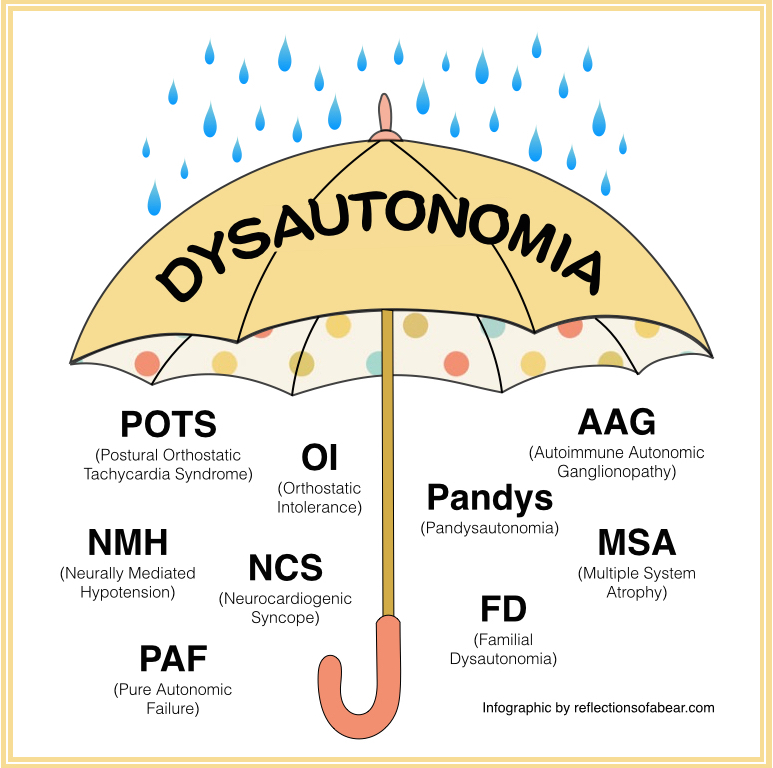
Dysuatonomia is referred to as an "umbrella term" because there are many subsets of the condition 

Feel free to join and participate! I bought some special shirts for me and my husband that will hopefully come in time.

If you would like more information about Dysautonomia, you can find accurate information and more resources for getting involved at Dysautonomia International.


So let's make noise for turquoise together, celebrate our strength, and raise some awareness together!


Here are some past posts that are helpful to understand Dysautonomia and living successfully with illness:


What have you been doing to celebrate Dysautonomia Awarenesss month? 

Thursday, April 2, 2015

Dysautonomia and Salt: A Love Story


Disclaimer: My degrees in the Humanities do not constitute a medical degree, and I cannot provide medical advice. Discuss any treatment you pursue with your doctor first

One of the first things you will hear after your diagnosis of Dysautonomia is to increase your fluid and salt intake. There’s nothing quite like the cognitive dissonance when your cardiologist tells you to begin a high sodium diet. The mechanisms that cause this problem are complex though simple: when you stand your body must compensate for gravity by increasing your heart rate to keep blood flowing to vital organs; your blood pressure drops a bit and your heart rate increases slightly. The autonomic nervous system regulates these automatic functions that happen in our bodies. At least this is the case for those who do not have a broken nervous system. With POTS, the body cannot compensate for gravity quickly enough. Blood pressure drops and the heart rate accelerates rapidly to keep blood moving to vital organs. With Dysautonomia, the longer you stand, the more blood pools into your legs and feet, making it difficult for the body to get blood to your heart and brain. This is why syncope (fainting) can be so common.

Low blood pressure can be very common with Dysautonomia. Salt helps the body hold onto fluids and raise blood pressure to allow the body to maintain some of the homoestatis the Dysautonomia-free take for granted. Many with Dysautonomia have hypovolemia, low blood volume, as well. Often salt and fluids are the first lines of defense doctors mention even before they discuss medication to manage the symptoms. Many with the condition receive regular saline IV infusions. I'd cut off my left arm to get access to this therapy, but my doctor has forbidden it. My doctor is a leading expert on POTS and has said he is wary of the efficacy of this therapy. I hope he changes his mind someday honestly. 

When I got ill and didn’t know I had POTS, I was weak, I lost about 15% of my body weight, and I could not stand for longer than a few seconds without feeling like I was going to faint. I went on an extreme diet of quinoa and vegetables for a few weeks to see if that would stabilize my system. Absolutely no sugar and no salt. I know now that was a mistake. I wasn’t receiving any medical care besides being told I was just crazy, so I was taking matters into my hands out of desperation. That entire time I craved bacon. I just wanted handfuls of bacon all the time (who doesn’t, right?). I think that was my body telling me I needed salt.

Bacon forever
Since getting a diagnosis, I’ve tried to perfect my regimen of salt and fluids and I wanted to share what I’ve learned over the last few years. Managing symptoms is often filled with trial and error—for the patient and the doctor. Since Dysautonomia presents uniquely for each individual, finding the right regimen can take some time. I’ve tried many forms of electrolytes and salt. Every single day is a desperate quest to get hydrated and be cool and upright like everyone else. I always have at least one drink at all times and usually 2-3 I'm drinking at once. Husband calls it "getting my drank on." This is how a POTSie parties. 

Salt
Salt may be your new BFF and trusty companion. It will always be there to help you get back up and keep fighting. My doctor recommended adding salt to my meals and I keep some sort of salty snack with me at all times.

Many with Dysautonomia become salt connoisseurs, purchasing different types of salt beyond the standard table salt. One type that many love and has become popular with the health-conscious is pink Himalayan salt. It looks like bath crystals but it’s actually salt. It’s been touted as a wonder product in the health community but I can’t find any reputable sources that provide specific evidence for the health benefits (if you know of any please let me know). Pink salt has other minerals besides sodium, making it closer to an electrolyte than a pure salt. I have started using it but haven’t noticed a difference with Kosher salt, which is what I usually use.

The drug most commonly used to treat Dysautonomia and its many forms is Florinef. I have a love-hate relationship with this drug. Many are completely dependent on it to treat syncope (fainting). It helps the body hold onto salt and fluids, which raises blood pressure. Some are advised to take salt pills in addition to the Florinef. I use Salt Sticks because my doctor explained they are less harsh on the stomach than ThermoTabs (which I have but haven’t tried yet). They are designed for athletes and have other minerals in them. My doctor also recommended taking one before I exercising. There is no hope of exercising without salt for me and for many with the condition.

There are drinks and snacks you can use to get salt as well. Some drink broth, pickle juice, eat pretzels, or pour salt onto fruits or vegetables. I drink at least one V8 a day, and when I’m feeling my worst a V8 provides instant relief. V8 has potassium and other vitamins in it as well, giving it some electrolyte properties. I keep a can in my purse at all times because I’ve had too many emergencies without it. I also eat salted almonds all day long.

Electrolytes
Our bodies rely on a careful balance of electrolytes to function, and with Dysautonomia the body struggles to maintain this balance. Drinking excessive amounts of water can flush the body of minerals, and Florinef may help the body hold onto salt but it can leech potassium and calcium from the body. Salt and water are not enough to maintain this balance, so electroyltes are essential in your arsenal of functionality because they give the body a mix of sodium, potassium, calcium, magnesium, other minerals to hold onto fluids and keep this balance. This is a list of different electrolytes I’ve tried but I recommend experimenting to see what works for you.

I’ve tried so many different types of electrolytes through the years that I’ve lost track. The most popular electrolyte on the market is Gatorade. I CANNOT stand the taste of Gatorade so much that I would drink it only out of pure desperation. In fact, during my last ER visit the doctor insisted I drink Gatorade before I could leave and I forced it down begrudgingly. It’s also filled with sugar, which is a common problem among the popular forms of electrolytes out there.

Finding the perfect electrolyte has been a Goldilocks endeavor to figure out which one is just right: not too expensive, provides lasting relief, tastes ok, not too much sugar, and easy to access. Pedialyte has been my go-to electrolyte for two years. It has all the minerals, lower sugar than Gatorade, and makes me feel instantly human. The problem is it’s prohibitively expensive. One bottle costs about $5-6. I would typically drink at least ½-1 bottle a day and on the days when I can’t get off the bathroom floor, I would drink two bottles. I don’t have a Starbucks habit anymore, but this Pedialyte habit became just as expensive.

This is about two months worth of Pedialyte bottles I drank
So I’ve been trying to find something else. I used to use Heed, a powder electrolyte, and mix it in tea and put it in a tumbler when I was teaching. It became less effective and didn't provide what I needed. That’s when I switched to Pedialyte. Powder electrolytes are great for mixing into water or other favorite drinks, and they have the added benefit of portability.

Many in the Dysautonomia community swear by Normalyte. From what I have seen, it seems to be the most popular. I gave it a try a few months ago and only made it through half a cup of it. It was too harsh on my stomach. My insides hate almost everything, and the GI symptoms are my most difficult POTS symptom. I believe it was the citrus flavoring that was the problem. I let my husband try it and he immediately proclaimed, “it tastes like the ocean!” I did not like it but many people use it exclusively. The makers of Normalyte are even working with Dysautonomia International to create a product designed just for Dysautonomia patients. When they do, I will happily try it again in support of this effort.


I also tried RecoverORS, which is marketed as “Pedialyte for adults.” Perfect, right? I also only made it through part of a glass of it. It was also a little harsh on my stomach. If you don’t have a delicate flower of a digestive system like me, these may work for you. They meet all of the other requirements, but I just could not tolerate them. I’ll keep them on hand for emergencies.

I had read that many also use Nuun tablets as their go-to electrolyte. I decided to give it a go about a month ago. Well, I haven’t had any Pedialyte in all that time. Nuun made all my dreams come true! It meets my Goldilocks standards and I haven’t looked back. I like that it’s also portable and comes in many flavors. It’s also much less expensive than Pedialyte at about $17 for 4 bottles of 12 tablets on Amazon. I’ve been drinking 1-2 tablets every day.

If you want a significantly cheaper option, you can also create your own electrolyte solution. You can find many recipes online, such as this one. 

Some drink coconut water regularly as well because it also has electrolyte minerals in it. You can find coconut water in most stores so it is very accessible. 

***


So if your doctor tells you to increase your fluid and salt intake, you have a lot of options to do this and help your body try to reclaim a semblance of homeostasis. I recommend experimenting to see what works best for you and don’t give up hope that you can find a regimen that can help you manage your symptoms.

Trying to fix feeling terrible and faint-y with some Nuun, V8, and tea. From my couch to yours, cheers!


Wednesday, October 29, 2014

Why Getting a Diagnosis Matters


I’ve been thinking a lot about why getting a diagnosis matters lately. Because many with Dysautonomia or other rarely diagnosed and invisible illnesses must go through months to years of appointments and testing to get a diagnosis, I have often wondered why we fight for one despite the constant obstacles and hurdles to obtain it. For many illnesses, especially rare and complicated ones, time to diagnosis is typically six years or more.

In 2011, I spent a year going through endless appointments and testing before I finally got diagnosed with POTS. I’ve spent most of the time since then going through endless appointments and testing to figure out what else is going wrong. Comorbities are common for Dysautonomia patients and they can spend years trying to obtain differential diagnoses. Never expect life to be easy, that's for sure!

I’ve mentioned before that about a year and a half ago I suddenly started having difficulty walking. I’ve gone from using a cane, to a walker, to now having to use my wheelchair if I leave house in that short amount of time. I am rarely able to leave the house at this point. Leaving the house is overrated anyway. Except, I miss it.

When I mentioned my walking issue to my doctor’s nurse practitioner when it started she basically told me I was imagining it. Invalidation all over again. So I tried to believe that for many months. But then I couldn’t get around and had to get a cane. I was continuing to lose my mobility rapidly. Hey, every 30 something goes through that difficult period of trying to figure out life while losing their mobility, right? Well, maybe not. I wasn't imagining this.

Having just one random illness no one has heard of is not a thing
I finally saw my neurologist this year. It had been two years between visits (the dude is popular and busy), and I told him what I was experiencing along with other disabling symptoms, he gave me a list of tests I would need to do. My heart sank. He was taking me more seriously but I knew all of those tests and appointments meant there would be no answers for at least another year. That was over seven months ago. I have only gotten progressively worse since then. My couch has a permanent Stefani shaped dent in it. 

While I fought to get the POTS diagnosis, I never dreamed of giving up. I'm in my fourth year of seeking a more complete diagnosis. The drive to give up has been surfacing from my subconscious, but that's not in my nature.

In one of the blood tests, I tested positive for an antibody for Myasthenia Gravis. Loss of mobility, weakness, difficulty breathing, and fatigue are signs of this autoimmune condition. In two weeks I do another test for MG. Maybe a diagnosis? My doctor had me start a medication last week that is used to treat this illness. But still, no official diagnosis. After all this time, will I finally know? But this led me to question why does a diagnosis matter? I am technically already being treated for this and have been learning how to cope with it, so why does the label matter?

Not many people want to be pigeon-holed and labeled. When you are desperately ill, that label is a like a trophy, engraved with the words "I Was Right!" Some never get a complete diagnosis and must suffer the costs of uncertainty long-term, but many of these patients still search for a label for their suffering. A label of an official diagnosis can matter for many reasons.


   Official Recognition and Documentation
Insurance companies and the medical system seem to operate in a very black and white world although there are some of us who live permanently in the grey area in between. There is nothing cut and dry about rare, complex conditions. Yet, a label and diagnosis fits into that tiny square in many medical forms titled “medical conditions" (good luck fitting more than one condition in that square). Having to list a grab bag of symptoms doesn’t seem to hold much weight in their world. Sometimes a grab bag of symptoms leads doctors or medical professionals to instead give a patient a psychiatric label such as “depressed” or “anxiety.” It’s easier than admitting they don’t know sometimes or investigating further. The irony is that depression and anxiety often are an effect of disabling symptoms met with invalidation, not the cause.

This is unfortunately incredibly common for many Dysautonomia patients. There can be serious ramifications from this invalidation. A lack of diagnosis could lead to patients not getting approved for a needed test or treatment option. It could mean a patient cannot get needed accommodations at work. It could impede accessibility to essential services for the chronically ill and disabled.

For those who are so disabled that they are unable to go to work or attend school, an official diagnosis could be a life line. This could help them qualify for disability or other types of assistance. For many, a diagnosis is essential for these practical concerns.

Often when you are chronically ill, you will encounter many doctors who do not know your medical history, you will have to fill out stacks of paperwork, and you will need to communicate to the medically uninitiated (such as employers, family members, etc) your needs. A diagnosis provides a concise explanation. 

Truth really is stranger than fiction. You can't make this stuff up. There’s nothing quite like having an entire Wikipedia page dedicated to your rare condition that you can direct them to when you have a diagnosis. The label leads to vital information and resources. It provides you with a prognosis and information to understand your body. A grab bag of symptoms rarely does. That leads to fruitless internet searches and typing into Google "am I dying?" The label can matter.
 
     Validation (Hey, I’m not just crazy!)
Finally leaving the inhospitable world of uncertainty behind for the more ordered, life-affirming nirvana of diagnosis gives patients validation, especially if they have been told they are wrong by many doctors. It lets patients at least take a break from the endless hamster wheel of diagnosis. This has practical financial, legal, and bureaucratic concerns as I mentioned above, but it also assuages the psyche of those who are desperately ill but have been denied proper care and treatment under the label of mental illness.

When I was finally diagnosed with POTS, I wanted to sing in the streets. Then I wanted to send the primary doctor I had who told me over and over “you’re just stressed” and ended up making me worse a flaming bag of dog poop. Ok, I won’t do that but I still think about it.

After being told by so many doctors that I was wrong, I was finally right. When you get a diagnosis, it's like reading a prequel to your life. The plot holes, disjointed timelines, and weird flashbacks of your story start to make sense.  I have learned that sometimes you will still encounter invalidation and continue to have to “prove” you are ill, yet you can wield a clinical diagnosis like a weapon against these forces. You aren’t wrong. You have proof. The label can matter. 

     Treatment
Perhaps most importantly, a diagnosis can lead to treatment options where there were none before. As with most rare conditions, no specific drug has been created to treat Dysautonomia and POTS as a whole, but there are drugs that treat symptoms such as Midodrine. Drugs are typically used off-label for Dysautonomia and POTS, such as Florinef (which was created for Addison’s Disease). The FDA did recently approve Droxidopa, an Orthostatic Hypotension drug.

It is difficult to treat a patient without a specific diagnosis, so finally getting that label gives a patient some options as opposed to few or none. Even with a probable diagnosis, you can have treatment options. For example, since my doctor suspects Myasthenia Gravis, I have started taking Mestonin and started physical therapy. Proper treatment can provide hope and can lead to a better quality of life. The label can matter.
 
 ***
HuffingtonPost posted an article listing other, innovative avenues for patients with complex conditions to pursue when you are trapped on the hamster wheel of diagnosis. POTS is even mentioned in the article, how about that! Depending on what happens over the next few months, I may pursue #3. 

I have been telling myself over the past year that perhaps a diagnosis doesn’t matter, but that’s the drive to give up talking. It does matter. The process to get there is painstaking to say the least but I have written before that there are ways to navigate it, which is here. 

Even if I also become one of those who must suffer a label-less existence, I know I'm not wrong, and that's what matters the most.

My last trip to Stanford Hospital. Keeping up the good fight

Why does getting a diagnosis matter or not matter to you?

Wednesday, September 17, 2014

Authenticity


Being on extended medical leave has been a strange ride. I spend most days couch-bound and riding waves of anxiety and sadness, trying to stay on a schedule to keep myself occupied by reading, writing, playing music, and maybe sometimes drawing. I’m also seeing things more clearly than I have in a long time. I sit outside in my yard and think about life and look clearly at the chaos that is happening around me. I want to make my experience useful for others on this blog, but I am still figuring this one out. I know others who are ill or disabled or face other challenges must struggle with living authentically. This is a strange ride indeed.

I have realized that I’ve been living a double life. Not an interesting or even sexy double life as a secret agent or a superhero. I’ve been living a very boring one. I’ve been pretending to be “well,” to be able to stand, drive, be accomplished and have a career, and then come home on the weekends and be bed-ridden, unable to do the basics like cook for myself or do laundry. My husband picked up the slack on everything else. 

I’ve been pretending to be one of them—living among the well who talk about traveling, doing yard work, or going places after work. Pretend to not be on an endless cycle of suffering and needing to go to the hospital. Pretend to not have just dragged myself off the floor of my office or the bathroom and then walked into a classroom to teach. 

But as I have been getting progressively worse this year, I have maxed out my credit card on pretending. My body will no longer let me pretend. I no longer have the will power to keep up the charade. 

This is a good thing because now I can try to live a more authentic life. I have been lying to everyone and to myself for a long time—lying about what I am really able to do and who I really am now. Maybe living authentically is easier for others with chronic illness, but I thought I was making illness look good. For whom?

I’ve never been much of a liar because I’m really bad at it. Bullshitting is not really my deal. But I can put on a stellar performance of being “well” that I start to wonder if theater was my calling.

I wanted people to think I could do it. I needed to believe I could do it. There’s too much at stake if I really can’t do it. I wanted to believe that if I pretended long enough that maybe the performance would become reality. Fake it until you make it, right? It didn’t work out for me. It only made me worse. My fairy godmother never came to give me some killer heels and turn this pumpkin into a new life.

But I can’t do it. The independent, ambitious woman I was a few years ago is now wholly dependent on others to get by. And that’s ok. I still use my polite words, “please” and “thank you.” I'm grateful for the friends and family who have shown their true colors and stood by me and for my husband, who is my hero.

So I’m going to try this authenticity thing. Reality is harsh. It means doing very little driving. It means not pushing myself so hard every day, which is second nature now. It means accepting that my options have narrowed and I may continue to get worse. I’m going to be honest with strangers, friends, family, myself about what I am able to do moment to moment. I am going to keep using the electric cart at stores no matter how many times I get dirty looks from the elderly. I'll use my wheelchair when I should. I'll use my shower chair with pride. I’m going to remind people that despite being young and having a rosy glow (that’s the makeup talking), I am not well.


It means that I no longer care so much what others think, and that is incredibly freeing. I can deal with the stares when I use my walker. I can now pluck up the courage to say “Pardon me, but I think I’m going to faint. Do you happen to have a fainting couch so I can make this look fabulous?” My illness is an unpredictable beast and I’m going to stop fighting it so hard. It means suffering in silence less and maybe becoming in tune with the world around me once again.The future is very uncertain but I'm getting more comfortable with that. I am gaining a lot of life XP in the process, and that is invaluable.

I don’t know what authenticity will look like, but I like the feel of it already. I am sick. I am unable to stand or walk for longer than a few seconds. I can’t breathe sometimes. I need to lie down. I am kind of broken. I am hard core. I’m a tough cookie. I am smart and educated. I am a warrior, fighting from a seated position with plenty of fluids, salt, and chocolate close by.


How do others live authentically despite adversity?