Showing posts with label chronic illness. Show all posts

Friday, July 8, 2016

Vacation!

I’m doing something crazy next week, something I haven’t done in years. We’re going on a vacation! I mentioned this before, but I haven’t left my town for something that isn’t medically-related in two years. 

Seriously. Two years.

I haven’t even gone to the next town over to see my BFF’s new place. She moved there almost two years ago. I haven’t made it to the Bay Area to visit my sister, about a two hour trip. She’s lived there for three years. I haven’t been to our favorite place, Sonora, an hour drive away, in two years, and the last time I went to Yosemite was three years ago. I haven’t even made it to any of my appointments at Stanford this year. I've had to cancel every single one. Travelling has become absurdly challenging, especially this year, so all of that has just not happened.

The last time we left town for something fun was when we went to Tahoe for a week with some friends two years ago. We had a great time. I wasn’t doing great but I was doing much better than I am now. I was still working at that time.  I had just survived the last semester I was able to teach and I was rapidly losing my mobility and independence at that time, but I wasn't completely couch-bound then. We played games most of the day and went out to eat most evenings. I sat on the porch that overlooked the forest and read much of the time. We went to the lake one evening as the sun was setting but I wasn’t able to last long so we didn’t get to watch the sun set.
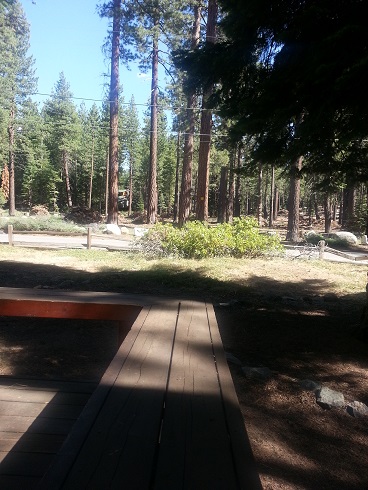
The view from the porch. Ah to live with this view every day. What a dream

I ended up at the ER on the last day we were there. That’s a story I still haven’t shared on the blog yet and I still might someday. If I could create a dream ER experience, it would have been that. I was treated quickly and the ER doctor, who was probably younger than me, had heard of POTS. That ER was incredibly busy. I got an IV and some Zofran and as I waited for the IV to finish we heard someone have a heart attack, someone who drowned in the lake, and the man in the bed next to me was withdrawing from something. The ER doctor forced me to drink Gatorade which I HATE because I declined a second bag of fluids. I just wanted to go home. After one bag, I felt ok enough to make the drive. Anytime I need to go the ER, I dream about go that hospital in Tahoe.

Mustering a smile as the IV worked its magic

We didn’t know at that time that I also had Myasthenia Gravis. I was having difficulty breathing and the lack of oxygen at high altitude did not help. I hadn’t even told my doctors at that point that I was having trouble breathing. The mountain thunderstorms that were passing through made me severely nauseous. It was a bit calamitous but aside from having to go the ER, I look back on the trip with fondness. I had a great time. I’m glad we were able to go somewhere while I was still able to travel. 

I just wish we would’ve stayed at sea level.

So this year we decided to go to Monterey with the same friends and stay in a house for a week. As I’ve been going through the worst health crisis I’ve ever had the last few months, I keep thinking “I have to make it to Monterey. I will make it no matter what.” I haven’t really been focused on much else at this point besides trying to get well enough to make it.  

We planned this trip awhile ago and I always imagined that I’d wake up each morning while we were there and do my usual routine of yoga, stretching, meditation. I never imagined I’d be using my wheelchair full time instead. In a few days, it will be two months since I’ve been unable to walk or stand. It’s not how I imagined this trip but it doesn’t mean I’ll enjoy it any less. We were planning on playing a lot of games too but more than likely I won’t be able to participate much, but that’s ok.

As a lifelong Californian, I've been to Monterey many times over the years so I definitely won't feel like I'm missing out since I'll have to spend most of my time on the couch while we're there. We were planning on going to the Aquarium, and that’s the main reason why we chose Monterey since the only way I could manage a trip to the Aquarium is if we stay multiple nights. I’m not sure I’ll feel well enough for that but it’s not off the table. Not sure I’ll be able to make it to the beach either but I’m definitely going to try. I'm mainly just looking forward to being somewhere that isn't obscenely hot and getting a change of scenery, from my couch to another couch.

I’m going to try to take some time off from being engaged in the world. It’s election season here in the US and I’ve been completely absorbed in that, global politics, and the violence that’s happening here. I may spend all of my time at home, but I’m still an engaged citizen of the world. But I definitely need some time away from that and running through the list of the all the appointments and health management I need to do in my head every day. There’s always something I have to prepare for, plan, make calls about. I’m going to take a much-needed break from it all.

When I get back, I get about a week to rest and then I have to do the worst test ever again (the Single Fiber EMG) at Stanford. But I don’t want to talk or think about that right now.

I’ve been trying to figure out what a suitable number of books bring is. If we’re there for five days, is four too many? What if I run out! What if I have nothing to read! The horror. I’m just going to take it all. Two works of fiction, one of philosophy, one of poetry, and my tablet in case I need anything else. Seems reasonable to me.

It was over 100 degrees essentially every day for a few weeks here. I was telling husband that I don’t even know how to pack for this trip because I don’t remember what 65 degrees even feels like. I’m going to enjoy being able to wear my higher quality compression stockings with jeans and being able to go outside. It won’t get cooler here until November so it’ll be a nice reprieve from the brutal heat.

I went out into public for the first time in months last week and it ended up being a bit disastrous since it was 104 that day. We went to my favorite antique store. I'm hoping that the cooler weather will make leaving the couch a little more feasible but we'll see. 

Husband and I at the antique store. No amount of air conditioning could save me at that point but it was nice to get out

I've been carefully planning for this trip for weeks now. Traveling while ill presents enormous challenges and it's difficult to make contingency plans for every form of chaos that can ensue. I've made a list of everything I'll need to take, including my meds, my breathing machine, shower chair, inhalers, my provisions and electrolytes, etc. Anytime I think of something, I write it down since my memory is unreliable. I'm working on packing a little every day so it doesn't completely exhaust me too much. 

I'm just going to cross my fingers and hope for the best.


I’ll probably be quiet on the Facebook page but follow me on Instagram or Twitter where I might be posting some pictures.


I’m hoping to get a ctrl-alt-delete on life, a nice reboot, and come back feeling a little more refreshed and renewed. I'll be listening to this song over and over, enjoying a little reasonable sunshine. 


Wednesday, March 2, 2016

The Month That Was

Since I didn’t manage to post any weekly updates in February, I’m going to do a monthly review—even though we’re in March now. 

Hello March! It’s great to see you.


-  February was a rough ride. I’m still trying to recover from the intestinal infection that started months ago, and I had to spend much of the last few weeks unable to leave my bed or couch. But I feel like I’m finally turning the corner. I had to cancel my brain MRI at Stanford (this is the third time I’ve had to cancel it), which doesn’t help my terrible record so far of showing up to appointments in 2016. 

Struggling to show up has made the emotional frustration of illness unmanageable. I put off writing this post until I could get my frustration under control. I can manage being bedridden and very ill for weeks on end but when I can’t show up to appointments, manage my care, or accomplish any of the basic things I need to do every day, then the frustration becomes unwieldy. 

The last few days have been better though. We’re having an unseasonably warm patch here in California. It’s hard to feel down when the sun is shining like it is.

- I’ve been very active my whole life and even though my body continues to become more limited, I’m still militant about exercising—to the point that I’m constantly overdoing it. I’m still learning that I can’t do the exercise I want to do. I have to do what works for my body and adapt to its abilities. The last few weeks, as soon as I start to feel a little better I try to get back on my stationary bike and then end up bedridden again. Exercise is essential for managing Dysautonomia and fending off de-conditioning, but since Myasthenia has taken over my body as well, I’m very limited in what I can do. If I push my body even slightly past its limits, the weakness turns into paralysis and my breathing completely shuts down. It’s really not cute.

So I’ve been starting to scale back and adapt my exercise routine. I’ve been doing a mix of simple yoga, pilates, and some of my physical therapy exercises in the morning, and I am seeing results! Usually, on the days I exercise I’m tapped out for the rest of the day but doing these simpler exercises doesn’t completely wipe me out for the day. I’m able to accomplish more.

A few years ago, I started to suddenly have balance issues and the problem, like many of my other symptoms, has only worsened since then. I do the exercises my physical therapist gave me to treat the balance problems but they’ve never helped much. They would only make a dent and wouldn’t have much lasting effect. It’s hard to tell but it seems like doing yoga poses every day actually has. I do the poses between a table and a wall so that I can catch myself when I inevitably fall. I used to do yoga regularly but this is a simpler version of what I used to be able to do. The poses I do that target balance are warrior pose, tree pose, balancing stick, and triangle. I often meditate after I do my exercise. Exercising is working best for me in the mornings right now so I'm rolling with it.

Yoga is definitely not for everyone so if you are considering it I’d recommend talking to your doctors or other medical professionals first to see if it could help you.

Doing Tree Pose like a boss. Like a wobbly boss

-  My improved balance has helped my mobility too. I have had to use mobility aids for a few years because of weakness from Myasthenia, balance problems, and orthostatic intolerance from POTS. Basically, whenever I am upright and moving my body is screaming “WHY WOULD YOU EVER DO THIS TO ME”. Yet, I still push myself to move. I try to get out and walk every day with my trekking poles, which my physical therapist suggested. They let me use mostly my upper body when I walk since my weakness is mostly concentrated in my legs and they give me added stability.

Last week I actually made it farther than I have in many months. I made it all the way to the corner of our street (about half a block). I was starting think I’d never make it that far again but I did! Husband took a picture for me to commemorate the moment. I’ve been walking to this point almost every day since! I'm thrilled.


-Monday was Rare Disease Day, which started initially in Europe but now has become a global event. The definition of a “rare disease” sometimes varies between countries. In the US, it is defined as a disease that affects fewer than 200,000 people. Myasthenia Gravis is considered a rare disease but POTS is considered a “rarely diagnosed” disease. Statistically, 1 in 100 teens are affected by Dysautonomia, but it is much less common to have initial symptoms later in life (which is what happened for me). Since Dysautonomia is an umbrella term, there are rare forms of it that qualify as a “rare disease” such as Pure Autonomic Failure or Familial Dysautonomia. Ehlers-Dalos Syndrome, a rare connective tissue disorder often associated with Dysautonomia, is a rare disease.


Rare Disease Day is a great opportunity to raise awareness about rare diseases since research and treatment options are so limited for these diseases and patients typically must endure many years of testing and even misdiagnosis to finally get a true diagnosis.

I had hoped to bring you information about the event sooner but I’ll have to aim for next year. We still have Myasthenia Gravis Awareness month in June, Invisible Illness Week likely in September, and Dysautonomia Awareness Month in October, but every day is an opportunity to raise awareness!

MyAware Ireland shared this video on Monday with a brief explanation of Myasthenia:


- A few posts ago, I outlined some of my goals for the year and I mentioned that I wanted to work on a few projects with husband, including my mom’s antique armoire she gave me many years ago that’s been sitting unfinished in our garage. A few weeks ago, I went out into the garage and husband had moved it into the middle and he said “let’s make it happen.” 

I can’t remember when my mom bought the armoire but I know I was a teenager or younger. She decided to refinish it and sanded it, but never finished it and decided to get rid of it. Before we moved to Nevada, I told her to keep it for me so I could have it someday. It’s sadly been sitting in a garage unfinished for over a decade but we finally finished it! Husband did about 85-90% of the work, but now it’s sitting in our room and I’m over the moon that it’s finally back to its full glory. I wish my mom could see how beautiful it turned out.


- I was supposed to spend Monday this week lying in the VERY LOUD TUBE for an hour and a half doing my brain MRI, but instead I was home working on recovering from February's douche-baggery. Instead, we played games with our friends. Game time is serious business for me, husband, and our friends. We try to play once a week and have been for years. Now, they move the table to the couch so I can play from there. It’s hard to feel down about life with good friends like this

All my favorite beards


I hope all of you out there are doing well! 

Friday, January 22, 2016

A Day in the Life


Instead of an update post this week, I have something a little different. My best friend Carrie Anne suggested I write a post like this and I thought it was a great idea. I outlined a typical day for me to show what managing illness looks like and what it means to enjoy life while battling life-limiting illness. This is what a pretty good day looks like, without any major catastrophes. I included a little of my thought process also. This is the Spoon Theory of illness in practice :

“It’s 9:00. I meant to wake up at 8:30. I set my alarm for 8:30. What happened? I didn't even hear my alarm. I always feel better physically if I can get up before 9:00. Oh well. I feel like I didn’t sleep. How many times did I wake up last night? Just the once or twice? I woke up when I heard husband leave at 3:30. Did I wake up because I wasn’t breathing? No. Not this time. Intestinal pain? Probably. I can’t nap so this will be as good as it gets today”

I get up and make the same breakfast I have every day: instant oatmeal with a scoop of peanut butter and extra salt. I had to give up any hope of eating real food in the morning a few years ago because my GI problems are the worst in the morning and I will instantly be lying on the bathroom floor if I try to eat real food. I’ve had a few disasters from trying to eat solid food and I'll just leave it there. I get most of the oatmeal down usually and my morning meds, which are my tachycardia med, Mestinon for Myasthenia (I can suddenly breathe again!), Florinef (oh how I hate thee but I cannot function without thee), imodium (food and I can be on speaking terms again), and a salt pill. 

I start hydrating as soon as I wake up and drink fluids (tea, water, V8, Nuun) non-stop until bedtime. That's what it takes with Dysautonomia. I do some of my vestibular exercises in the morning (standing still for 30 seconds and trying not to fall from the swaying). This is supposed to help counteract my balance issues, even though they aren't vestibular related. It usually helps slightly.

“I’ve been sitting here watching mindless television for an hour. I got my food and meds down. Do I attempt exercise? I could get on the stationary bike, or try to walk, or do some strength, or just meditate instead and try to exercise this evening? It’s a risk either way. I could waste all my energy on exercise and risk not being able to make myself lunch or be able to do anything else. I’m going to risk it. Exercise seems to be going better in the morning. I might not have any energy left this evening. I better do it now.”

I do one of those options but never push it too hard so that I have enough energy still left. The “exercise” I do is only 10 minutes or less and very minimal. As a former athlete and someone who has always been very active, it feels pathetic but I know it is still a huge success if I can do it and if the weakness/paralysis isn’t bad enough that I can get some use from my legs. With Myasthenia, the more you use a muscle, the more weak it gets and if I'm having a rough patch, the paralysis could set in for days or weeks. I have to be very careful with how much exercise or movement I do because my legs especially will completely shut down if I ask too much from them. Sometimes I end up spending all of my energy on exercising and sometimes I finish exercising feeling slightly invigorated with more energy. It’s a crapshoot every time. 

I put my compression stockings on (if I exercise, this happens first), get dressed, do my makeup, brush my hair (maybe curl it), and listen to NPR news. I may be home-bound now but that hasn’t changed my perpetual desire for news and politics. I need to know what’s happening in the world even if I’m barely part of it. I’m still a citizen of the world.

I usually waste copious energy on getting ready. This is a controversial subject in the spoonie community. I get dressed and do my makeup every day, even when I’m not leaving the house, and I willingly waste much energy on this. It is my war paint, it is my normalcy, and it is how I know the difference between ok days and horrific days. Horrific days are ones where I cannot get dressed or put make up on or leave my bed. It’s a dash of vanity too. I don’t want anyone to be able to look at me and see the struggle etched on my face.

My mother taught me so much about self-presentation and feeling good about yourself through that presentation. Even when we were destitute and she was a single mother, she always looked fantastic and had high esteem about her appearance. It’s something I still value even if I don’t leave the house most days. I like to know that if a miracle happens and I have enough energy to leave the house or if someone comes by, I will at least be ready.

I won’t feel the part but I’ll at least look it.

“It’s 11:30. I have a little time before the Big Crash comes. It’s just all downhill until I can take my afternoon dose of Mestinon at 4. So many hours from now. This is the worst time of day for me so it’s time to sit. Sit and rest. My to-do list still has so much left on it for the week. I have phone calls to make, appointments to set up, paperwork to fax, I have to talk to the disability insurance company again. I can’t believe I have to call them again this week. It never ends. There’s never a week where I don’t have to do something related to managing my own care. What if I took a week off? Maybe in June? A whole week where I don’t do any of this? Maybe.”


"Sit still. I have to make lunch somehow in an hour and I need to rest for that. I’ll make the phone call after lunch. After I use my afternoon dose of my inhaler. That way I won’t be gasping for breath once I get off the phone. The only way I can sit still is if I force myself to read or watch something. I’ll watch another episode of Time Team. I never get tired of Time Team. One episode is enough time to be still and rest before I have to make lunch. Do I have enough energy to make myself something besides the usual eggs I eat for lunch every day? It’s a nice thought. The pain in my intestines tells me that I shouldn’t risk trying to eat other food anyway.”

I watch an episode of Time Team, one I’ve probably already seen and have the dialogue memorized, or a documentary or live music on YouTube. Then I try to get enough energy to make myself lunch and maybe unload the dishwasher in stages. I take an hour to eat lunch, which is the amount of time I need for each meal. Because of the Dumping Syndrome related to Dysautonomia, I have to eat very slowly. That way I can get enough calories and the food has a good chance of actually staying in my body long enough to digest it. 

All cooking is done while sitting, of course!
“It’s 1:00. I guess I’ll make that phone call. Then I’ll sit outside in the yard for a bit. That sounds lovely. That will be my reward for getting this off my to-do list. The birds in my yard always hang out with me when I’m out there. They make me feel like Snow White, if Snow White was a crippled, recovering academic with a Zeppelin habit. I’ll read or work on some writing while I’m out there. Or just listen to music. Or read the news. Either way, it will help me sit still and rest. I’ll check Twitter and see what my friends and spoonie friends are up to, or what political nonsense is happening. Look at the sky. Feel good about life and my place in the universe at this moment.”


Husband gets home in the afternoon and we talk about how his day went. He lets me vent my frustration about American politics or whatever news I read. We laugh at some random thing we saw online or heard and banter about our nerd interests. Then he usually plays video games and I read or work on some writing for awhile.

As my morning Mestinon dose starts to wear off, the afternoon is a slow climb. It’s the worst time of day for me so I try to spend most of it resting. My inclination is to keep moving, try to clean, do things, so I really have to force myself to rest during the day. If I push myself, then I can end up bedridden and struggling to breathe and move. Then the day is completely over. It's a constant balance to try to stay mobile and active enough while resting significantly. By 4 PM I can take my afternoon dose and then things start to turn around a bit. I can breathe better, have more energy, and more use of my limbs. I can maybe try to go for a walk or do a bit of cleaning or play my keyboard for 15 minutes. Usually I keep resting. If I don’t eat dinner by 6 PM, I start crashing again.


Husband makes dinner most days. Cooking complicated meals is just not something I’m able to do anymore, so he does the cooking. But it’s a fair trade because I do all the clean up. I don’t mind doing that part. It feels like my contribution. I take my vitamins with my dinner since I have the best success with food at that time.

The evening is the best part of the day because that's our quality time. We usually eat our dinner and watch whatever Sci Fi show we’re currently watching. I also watch the news at 5:30 every day. We sit on the couch and watch our show with our cats and then husband goes to bed around 8:30. I go to bed later than him so sometimes I’ll go in and lie down with him for awhile. We’ll grab one of the cats and have a team snuggle for 15 minutes and then husband falls asleep.


I usually shower, a very quick, lukewarm shower with my shower chair as one with Dysautonomia must take. A hot shower is one of the worst things you can do with Dysautonomia because it dilates the blood vessels and your body is already having a difficult time keeping blood flowing to your heart and brain from blood pooling. Gravity combined with heat is Dysautonomia kryponite. That’s how one ends up unconscious on the shower floor, which is not sexy. Even with the fast, lukewarm shower while sitting on my shower chair, I can feel my brain start to turn off by the end of the shower so I rush through it. After I shower, I sit for a bit and rest. I can’t shower in the morning anymore unfortunately. If I do, it could take me all day to recover from it. Evening is usually a success.

Around 8 PM, I usually get my second wind or at least a small surge of energy. I usually finish the dishes if I haven’t already or try to do some of my very easy physical therapy exercises. In the summer, I sit outside and read since I can’t go outside during the day. I loathe summer now but eating my breakfast outside in the morning and then sitting outside in the evening and reading are both real treats. I look forward to that bit at least.

“It’s 9 PM so I have an hour or so before I take the next round of meds and start preparing for bed. Should I try to exercise more? No. I did enough today. I have to save some energy for tomorrow. Do I watch some crappy tv? Or read? Maybe I could try to mop? I’d give anything to mop. I need to invent a vacuum cleaner/mop that I could ride because I just cannot successfully do that now. I miss the days when I could clean our whole house in an hour. Now so little gets done. Thank god no one ever sees our room and bathroom. I need to learn to live with it. It’s not the end of the world. I did enough today. It was good enough.”

“Maybe I could try to drive tomorrow? It’s been almost a year. Maybe I could walk all the way across the street? It’s been so long. Maybe I could go somewhere with husband? I don’t want to get my hopes up. I’ll just take whatever my body throws at me and accept it. I had an ok day today so I just need to be satisfied with it."

"I didn't have to spend any time in bed, and that my dear is glorious.”

“But I need to sit and rest before bed. I should do my evening dose of my steroid inhaler now. I may need a hit of my rescue inhaler before bed since I’m not breathing great. Hopefully they’ll both be enough to breathe ok through the night. I don’t want to have to use them back to back right before bed. That will lead to endless coughing and could keep me up. I’ll use it now.”

Then I take my evening meds and try to get to bed before 11. I usually feel my best if I can get to bed by 10:30 and wake up around 8, but I’ve always been a night owl. I wish I could stay up later, but those are days are over. I lie in bed and read for awhile, my cat climbs up next to me, and then I eventually fall asleep to start the day all over again.


***
What I hope to show with this is a little of what it’s like to manage chronic illness day to day and a little of what it’s like for those who are so ill that they are home-bound. This is actually what an ideal day looks like, without having to spend any time in bed and accomplishing a few things. Perhaps I'll outline a really bad day sometime, but it won't be an easy read that's for sure. I hope I showed not just the constant battle of managing illness, but more importantly, what it means to live a good life despite it—what it is to attempt to thrive despite a body strained by affliction and in constant chaos. 

This wasn’t my normal a few years ago because I was working still. I left the house every day. I lived among the rest who have a career and a sense of purpose. But this is my normal now and I have adjusted to it. My sense of purpose has changed significantly and often that purpose is just to try to make the most of each moment, in the hopes that I’ll feel well enough to enjoy it fully. 

I never know what I will wake up to each day or how I will feel moment to moment. The day can vary so widely that it is often impossible to predict what I’ll be able to do. But no matter what the day becomes, I have learned how to feel satisfied with whatever I get and whatever I'm able to do. It's not an ideal life, but it is still a good life. A good life indeed.


Sunday, November 8, 2015

Month of Gratitude, Week One: Satisfaction


As it is the month for gratitude, I am going to write at least one post a week this month discussing illness and gratitude. Although illness has taken many important things from me, there are many gifts it has given in return. One of the most important lessons illness has given me is to learn how to be satisfied and gracious in that satisfaction.

Dissatisfaction is a state of being for many of us, and it can be a valuable tool to help us achieve goals. I lived most of my life always thinking, literally, “what’s next?” I wouldn’t have been able to go to grad school twice, achieve my goal of getting a tenure-track professor position, climb mountains, or power through illness like a warrior the last few years if I didn’t know how to channel “what’s next?” into achieving goals.

Yet, this “what’s next?” also pushed me to make choices that weren’t good for my health and, more importantly, it blinded me to the immeasurable gifts I already had in my life. If I have one regret since getting ill it is that I took too much for granted and didn’t appreciate what I once had that is now gone. “What’s next” was a distraction from being mindfully present and allowing myself to surrender to satisfaction, to look around me and feel grateful for my life.

We are trained from a very young age to never be satisfied. We are conditioned to become consumers from the moment we are born and to look for “bigger and better.” Satisfaction, in American culture especially, is a truly radical idea. Everywhere we turn, we are constantly persuaded to want more and to be more. “Bigger and better” and “what’s next” are illusions; they create desires that can never be quenched.

Yet, as the speed in which my world spins has slackened, as the alacrity of my own body has dampened and my legs—once athletic and invincible—stumble along at a glacial pace now, I am now still much of the time. It has helped my mind be still as well. In moments that are thick with suffering when I’m lying in bed and surviving moment to moment, I am forced to live in the present. The pace of my world has significantly decelerated, but the images of life are no longer blurred in speed. They have color, texture, definition.

It seems ironic that illness would give me this lesson. If we are often told “your health is the most important aspect of life,” then you would think living with a life-limiting illness would be the most unsatisfactory state of being. Yet, “your health is the most important thing” is a platitude; it assumes that those of us who live with chronic illness have nothing because we don’t have “our health.” This is fundamentally false. The loss of my health and my independence has taught me to value what I still have and despite being ill I can still enjoy what I still have.

It has taught me that there are moments to savor in life. There are moments when all of the ingredients of life—the people in our lives, the words we say to each other, our perceptions of the world, our self-image—meld into something truly delectable. These are the moments when we can feel truly alive, feel the electricity of being human. These moments were not on my radar before illness—before I was forced to be still and live in the present. When you live under the spell of “what’s next,” it’s easy for these moments to pass by.

I try to find moments throughout the day to just breathe in satisfaction and feel it completely. 

Feel...

Satisfied with the limitations I have now and what I can still do

Satisfied with my appearance

Satisfied with spending most of my time at home

Satisfied with each moment I get to be outside and be part of the world

Satisfied with my relationships

Satisfied with my material possessions

Satisfied with how I physically feel in this moment right now

Satisfied with my talents and abilities

Satisfied that the present is here but the future is a mirage

Satisfied with the treatment I have right now

Satisfied with the time I had with my mother

Satisfied with the change I am able to enact in the world

Satisfied with the energy I can give to others

Satisfied that my condition may get worse or get better

Satisfied that I may work again or I may not

Satisfied that my place in the world is just as it should be right now


Feeling satisfied at times doesn't have to stop us from setting goals and seeking improvement in our lives and in the world around us, but it's ok every once in awhile to appreciate and value that what we have is enough. Satisfaction also doesn’t have to be a constant current and it is by no means a constant sensation for me, but illness has forced me to look around at the world and appreciate the gift of life. It is an integral part of living with acceptance. In those delectable moments I can say thank you for the giftedness of life, even if it’s just for a breath—but I’ll make it a long breath and try to feel an entire lifetime of satisfaction in that moment.


I hope that you also have moments of pure satisfaction, moments where you can just stop and say "thank you."

How has illness or any other setback in life helped you feel gratitude? 


Here's a great TED Talk about gratitude: "It is not happiness that makes us grateful. It's gratefulness that makes us happy"

Thursday, August 6, 2015

Spoonie Reads: Toni Bernhard's "How to Be Sick"

I’m excited to start this new section on the blog today. I have wanted to start it for some time. Like many of you, I find the best way to understand anything that is nebulous is to read about it. What could be more absurd and confusing than illness, right? As an academic, the first place I always turn when I have questions or need context is a book. So as I read more books that relate to illness, I’ll write a post about them and try to explain how they are useful if you would like to read them. 

Many who have chronic illness—those who are newly diagnosed, undiagnosed, or diagnosed many years—have turned to Toni Bernhard’s How to be Sick: A Buddhist-Inspired GuideFor the Chronically Ill and Their Caregivers. It’s a great starting place for understanding what life with chronic illness entails and how to navigate the treacherous waters that come with it. Although Bernhard uses Buddhism as a framework for understanding illness, the text does not cover the tenets or history of Buddhism nor is it designed to convert. Buddhism is discussed as a tool for coping with illness, but it is not the focus of the book.


The book is geared specifically to those with illness and those who care for or care about anyone with an illness. You won’t find medical research or specific information about disease. The author does have Chronic Fatigue Syndrome (ME) and POTS, which I hadn’t realized until I started reading it. Yet, she makes this book accessible no matter what illness the reader may be coping with. You won’t find information about the practical, gritty concerns of illness in this book such as navigating the medical system, applying for benefits, managing specific conditions, etc. This is essentially a self-help book that borders on psychological cognitive therapy. Bernhard's intention is to help those who suffer with illness work toward acceptance and make peace with their irrevocably altered life. Using Buddhist teachings and the concept of mindfulness, she offers cognitive pathways throughout the book that are designed to help those with illness be mindful of destructive thought processes and re-orient them instead to be productive and positive.

The strength of this book is its accuracy in representing the universal experience of illness. She touches on all of the cardinal obstacles many with chronic illness will at some point face: doubt and insensitive comments from doctors and friends and family, grieving a former life, self-blame, confusion and frustration, the long road to acceptance, seeking answers when none may exist, and courageously rebuilding a life despite illness. It is the last point that is the overlaying theme of the book. No matter how resilient you are, that resilience will be tested after illness and Bernhard offers suggestions for reclaiming that resilience. 

She begins the book by stating that a basic tenet of Buddhism is that “life is suffering,” explaining that this is not a gesture toward resignation but instead acceptance that life is in constant flux. She mentions that this should be a source of strength. To understand this, she says she repeats to herself “You know this is the way it is. You were born and so are subject to change, disease, and ultimately death. It happens differently for each person. This is one of the ways it’s happening to you.” Suffering can be used as an emancipatory concept to accept what you are experiencing and find a way to thrive and let go of the self-blame that is so common with chronic illness. Suffering as a form of strength and perseverance underpins many of her points throughout the text. 

There are a few points throughout the book that were memorable to me that I will mention, and even though I read this book a year ago, they have continued to help me with the tough emotional work of managing illness. She discusses the Buddhist idea that there is “no fixed self,” meaning that the “I” we use to understand ourselves and the world, is constantly changing. Thinking of ourselves and our bodies this way is useful for seeing our experience of illness objectively. She states, “contemplating the truth of no-fixed-self has helped me tremendously since I became chronically ill” because “what happens in life arises out of conditions, not from a ‘me’ in control.” Relinquishing this sense of control or the idea of any fixed state of being is useful on the really bad days. It can be a source of hope. She has a mantra to remind herself of this: “there is sickness here, but I am not sick.” I have repeated this on my bed-ridden days. It’s useful to remember that illness is not my identity and the experience of illness and life in general is constantly changing. The bad days and moments are transient.

Sometimes it feels like illness washes the entire world in a grey haze, but maintaining our humanity and remembering to feel joy is still essential. When I can’t do the things I want to do or be with my friends and family, I think about what Bernhard said about “cultivating joy in the joy of others.” This is a good antidote to the inevitable envy of those who are well that so many of us experience. When I can’t go to an event or leave the house, I try to feel joy that my friends are spending time with each and they are having fun. It’s difficult to do, but it always helps me get around the disappointment.

For me, the most useful point she makes is learning how to feel compassion for ourselves and our bodies. I have spent most of the years I’ve been ill punishing my body for being ill and forcing it to do things it is incapable of doing because I refused to accept my limitations. This obviously led to enormous frustration. It’s a product of guilt and self-blame. But Bernhard mentions that feeling compassion toward our own suffering is a way to surrender, accept, and cope: “When cultivating a compassionate mental state, sometimes I look for words that address the source of the suffering … I might silently say ‘It’s so hard to want to so badly not to be sick … my poor body, working so hard to feel better.” On the really bad days or when I feel like giving up, I think of these words and feel some compassion for myself instead of blaming myself for struggling to endure.

There is much more in this book that offers useful cognitive re-framing to understand and manage illness than what I mentioned here. After reading it, I did wish for more depth in terms of narrative and the application of these points, but perhaps that’s more a matter of personal taste than a deficiency in the book. I have some parallel experiences to hers, which I found so amusing that I talked to her on Twitter about it. We’re both academics, have POTS, and live in California’s Central Valley. When she mentions the embarrassing lengths she had to go to while teaching and being severely ill, I had a visceral connection with her. I had to do the same thing.

This book is educational in learning how to do more than just exist and survive with illness. It can help you on your path of learning to live well and fully while ill.

This book has been so successful that she has written multiple sequels to it that focus on other topics. I recommend this text in your studies of chronic illness and managing your condition or even understanding how a loved one lives with illness. You can find her website with a list of her books at www.tonibernhard.com.

Cheers and happy reading! 

Friday, July 17, 2015

When Love Prevails


My husband and I celebrated our ninth wedding anniversary at the end of June, which gave me a chance to really reflect on the challenges we’ve faced and the great life we’ve made together. The strength of our love for each other has weathered some serious setbacks over the last few years but I think it has been made stronger by these hardships. We've found a way to value the memories we have and laugh about the absurdities of life. 

Maybe you know my husband. Maybe you don’t. If you do know him in person, you may not know the full story. My husband is goofy, hilarious, sharp-witted, a gifted artist and maker of things. He has an encyclopedic knowledge of animals. He is an athlete as much as he is a nerd and has spent a good portion of his life playing D&D.

He is also the sole breadwinner in our family and has had to assume the role of caregiver as well, and he has done so without complaint. I think the key to marriage is to marry someone who is a better person than you and who in turn makes you a better person. Also, find someone who is as much of a weirdo as you are. I lucked out.

I met him in high school when we had a mutual friend who my husband would draw comics with. When we had art class together senior year, I thought he was one of the most obnoxious human beings I had ever encountered (but pretty cute). He was so effortlessly happy all the time, laughing and finger-painting with his friends. I was an angry person with some serious unresolved issues then and suffering through 8 A.M. art class didn’t help my demeanor.

We had another mutual friend who helped us connect during our first year in college. When we started meeting at a coffee shop to do homework together, I saw that his happy-go-lucky attitude had been tinged with some cynicism and I had started resolving my anger to be a little more at peace with the world. We met somewhere near the middle. We started dating and my husband moved in with me and my parents within a few months. We knew it was life-long from the get go.


We’ve had a few bumpy patches from the beginning, and my health has never been great, but we saw our lives stretched out in endless possibilities. One of our favorite pastimes was to talk about our dreams and goals, make 5 year and 10 year plans. We were broke but we were happy. We spent our 20s hiking, playing video games, spending a lot of time with our family and friends, trash-talking each other during board games. I look back on this time with fondness.  

We've had so many great memories along the way. He took on the role of a roadie as I was performing often and he would carry my equipment wherever I played. We would drive to the foothills on a whim and pay his grandma a surprise visit. We would visit his aunts in southern California and play games and go to the LA zoo. I never realized families were not all dysfunctional until I met his family. They are some of my favorite people. 


My parents took us to Hawai'i twice years ago and snorkeling, boogie boarding, swimming in the ocean together, sitting on the beach with my family are probably some of my favorite memories still.  


We literally climbed mountains together and have put in a lot of miles hiking Yosemite. Halfway through most hikes, I would be struggling and he would offer words of encouragement. Suffering and cursing my body, we’d eventually reach the top together and it always felt like a miracle. The climb down together was the easy part. This continues to be a metaphor for our lives together. Every day is a miracle.


I was in college almost all of the time we’ve been together and working at least one job, nose to the grindstone always. He worked jobs that allowed him time for his hobbies, making sure every day was filled with “good times.” As my friends and I in grad school often lamented that our lives were spent working for nothing 7 days a week, he jokingly would say “life choices.” I didn’t realize he chose the smarter path until I left grad school for good.

He always supported my long-suffering, financially precarious academic habit and even agreed to leave his home and friends and move to Nevada with me so I could do the absolute absurd: try to get a PhD in literature. He was in a motorcycle accident within a few weeks of moving there. His beloved scooter was toast and now he now has a bionic arm from the ordeal, although he suggested to the EMTs in the ambulance that he wanted a hook if he had lost his arm. We often joke that Reno tried to kill us both.


We made a good life for ourselves in Nevada, became liberal gun owners (as one does in Nevada) and would go target shooting in the desert, we watched wild horses roaming in the desert, did some hiking, and saw ourselves potentially staying there for good.


But I guess plans, especially ones that are carefully orchestrated and plotted, are made to be undone.

After I got ill in 2011, all the plans we had made were in question, and I wanted to go home and try to reclaim some sense of normalcy. Once again, he agreed to move back to California despite how much he loved living in Nevada. Our lives since then have been filled with ups and downs, including years where I am working and contributing and years where I’m not.

Every time our plans come crashing down, we gather the pieces and put them back together—creating something new, adjusting to a transformed reality and carving out a way to thrive in it. I would say we have been successful—at least successful on our own terms. We have become professionals at adapting and adjusting on the fly.

I’ve been watching all of The West Wing and am intrigued by the storyline of President Bartlet’s Multiple Sclerosis. In one episode, his MS left him paralyzed and as the First Lady helps him get into in his pants, he looks at her and says, “I guess this is what vows are for.” Indeed. Through sickness and health. Through thick and thin.


We have adjusted. We are adjusting. Although we aren’t able to do many of the things we used to do together, we haven’t lost everything—not by any means. We still have sci fi shows, video games, board games, Led Zeppelin, making art, philosophical debates, and the occasional excursion into nature. We're making new memories with our families, our crazy nephews, our friends who are more like family. We're still a bunch of nerds. 

I often read other's stories who have lost so much because of illness, including the dissolution of what they thought were unbreakable vows. I think we are aware that things could be much worse and I wake up and go to bed every day with a conscious, determined sense of gratitude. As often as I come across stories of dissolution, I find stories of people who found a way to use catastrophe to build stronger bonds. The material realities that we believe determine so much of our lives, our identities, our relationships—I have learned—ultimately mean very little. If nothing else, this is one of the most invaluable lessons illness can provide.


Every time we hit a setback, I am often panicking, worrying, filled with fear. My husband just accepts the setback and figures out a way forward. He is brilliant at finding solutions and fixing things that seem irrevocably broken. My ringtone when he calls is the MacGyver theme song. I may have the degrees but he is the real brains behind the show. While I’m pondering the abstract, he is coordinating the particulars. Somehow we find a way to reach the top of the mountain together.

Most people don’t have to manage these obstacles at this age. Most don’t expect to have to be a caregiver for a spouse in your 30s. And this hasn’t been our only challenge faced too soon. We had to place my mother in a convalescent home earlier this year, far earlier than expected for her age. It often feels like we have lived a lifetime in the span of a few years, but we have weathered these setbacks with our love for each other and with the support of our family and friends. For our tenth anniversary next year, I am hoping we can have a party to celebrate with all of them. We need cake, good food, and great music.

We try to laugh about the absurdity of our lives often. Finding the absurdity in any situation is one our strengths. I told him once "I guess I'm now your trophy wife." He replied, "No. You're my trophy wheels." 

Every relationship will face some kind of test at some point, and every time you get to other side of it together, the narrative of the bond you share widens and deepens. The story of your entwined destinies motions to new hope, new challenges, new utterances of strength. Ultimately, you choose to face what remains still unwritten together, and that, more than anything, is the bravery of love.